Recently the Chief of Cape Three Points was asked by a visitor to outline the needs of his community. His answer was quick and unwavering – electricity for the village, and an accessible all weather road for the area.
For some folks here in Ghana, the name “Cape Three Points” is synonymous with oil and riches, but for people like myself who frequently visit the village that gave the offshore oilfield its name, the name conjures up respect for the resiliency and good humour of its citizens. For far too long, they have been isolated from their share of the improving economics of the country because of the poor condition of the road which leads in and out of their area.
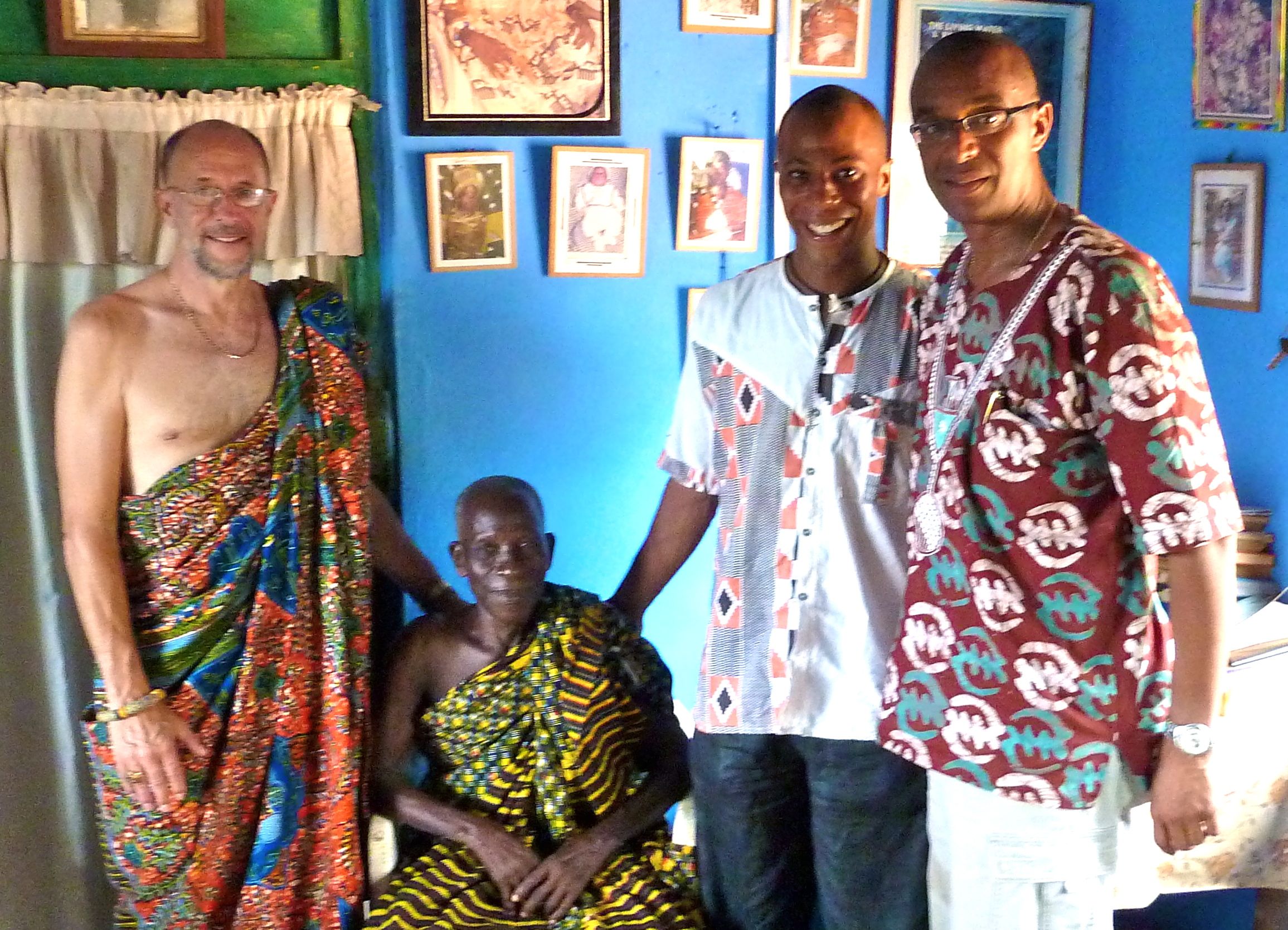
The author with Nana, the author's son, and a visitor
From where one leaves the pavement on the Agona/Dixcove branch, the dirt road is dusty and extremely rough in the dry season, and muddy and often impassable for anything other than the most robust four wheel drive vehicle when it rains. There are countless streams, lagoons and low lying areas to pass over and through on the way to Cape Three Points and just as many bridges of various types and in different states of repair. Any one of them could prevent someone from completing their journey in or out of the village, emergency or not.
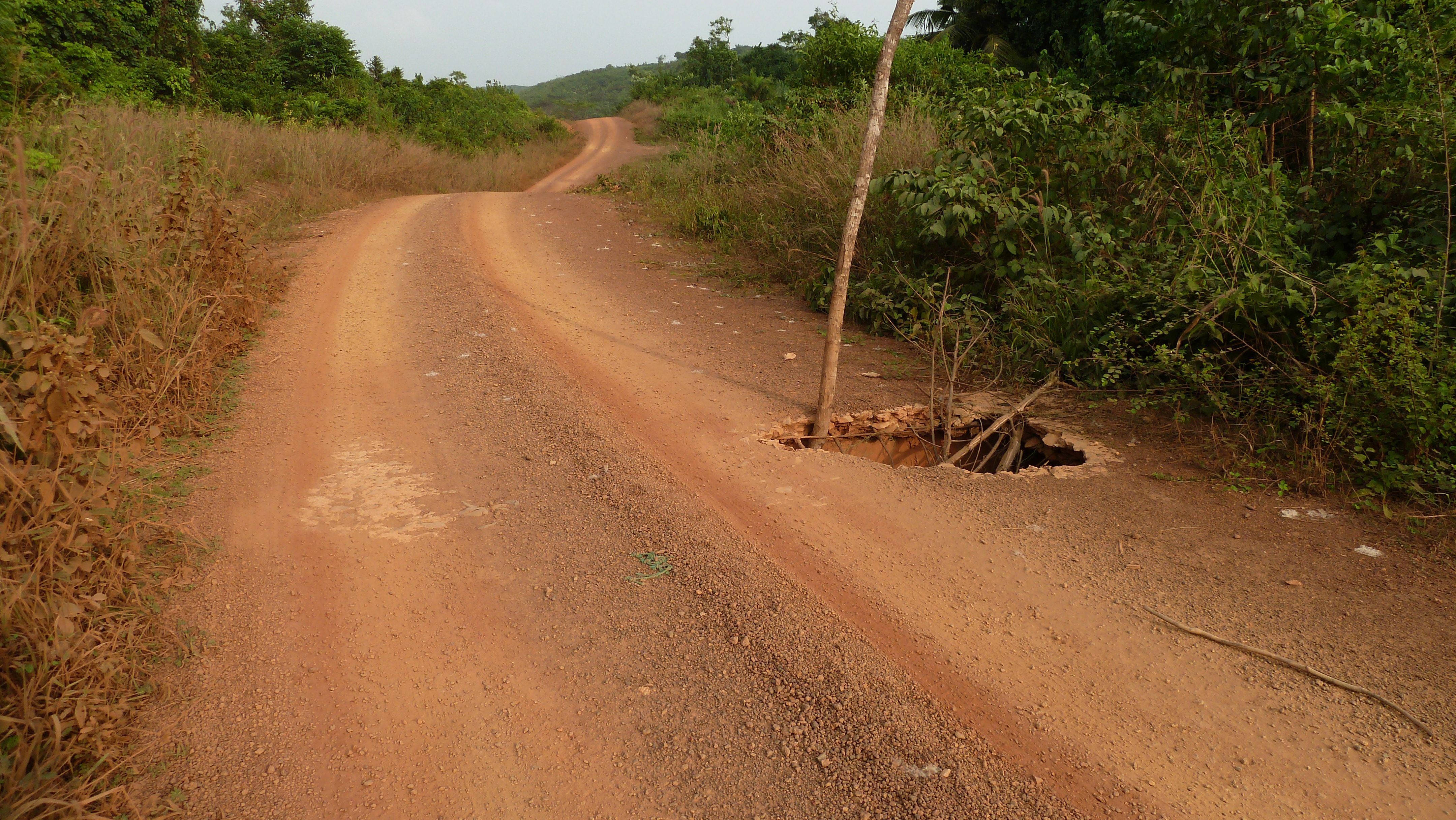
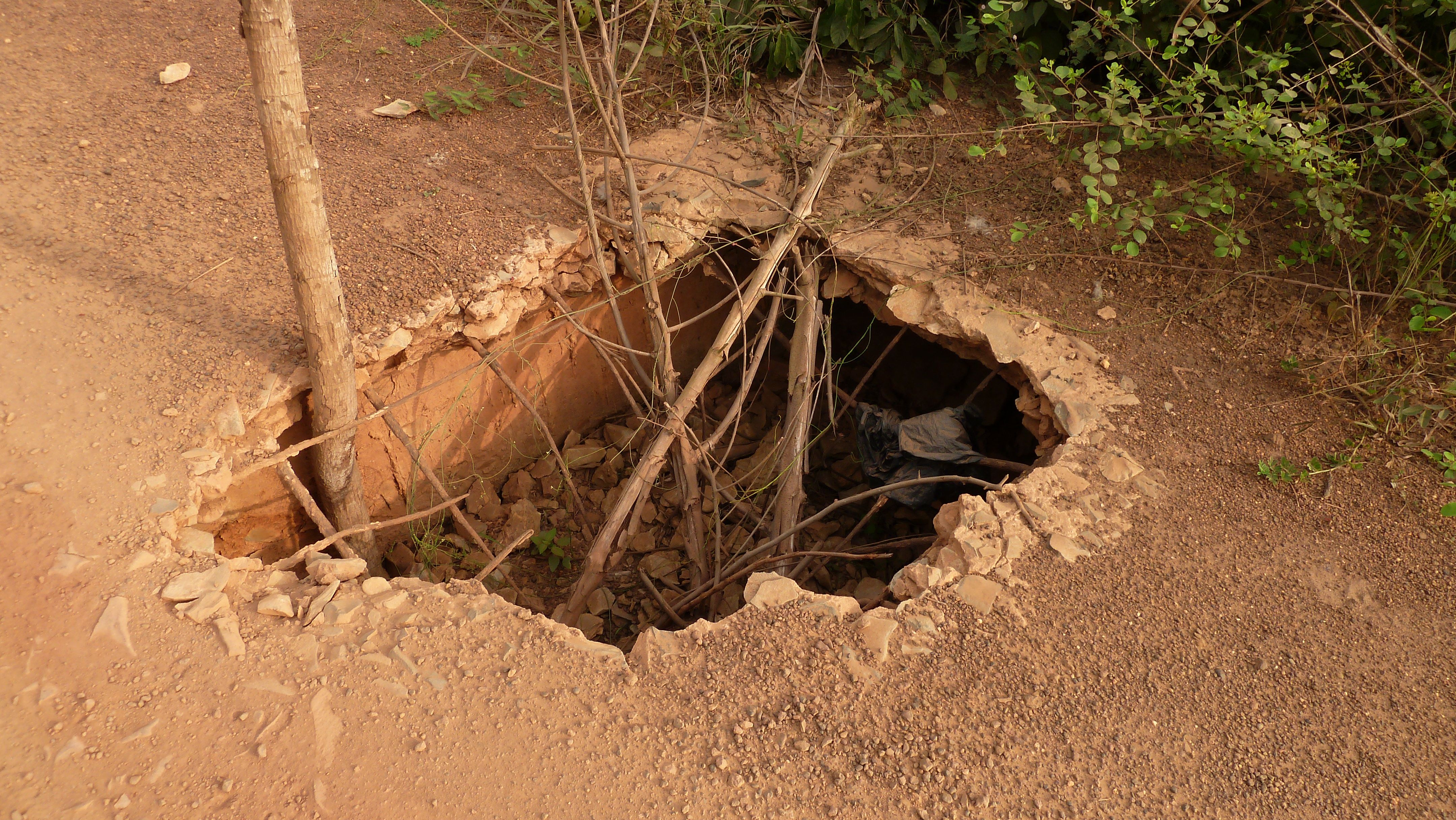
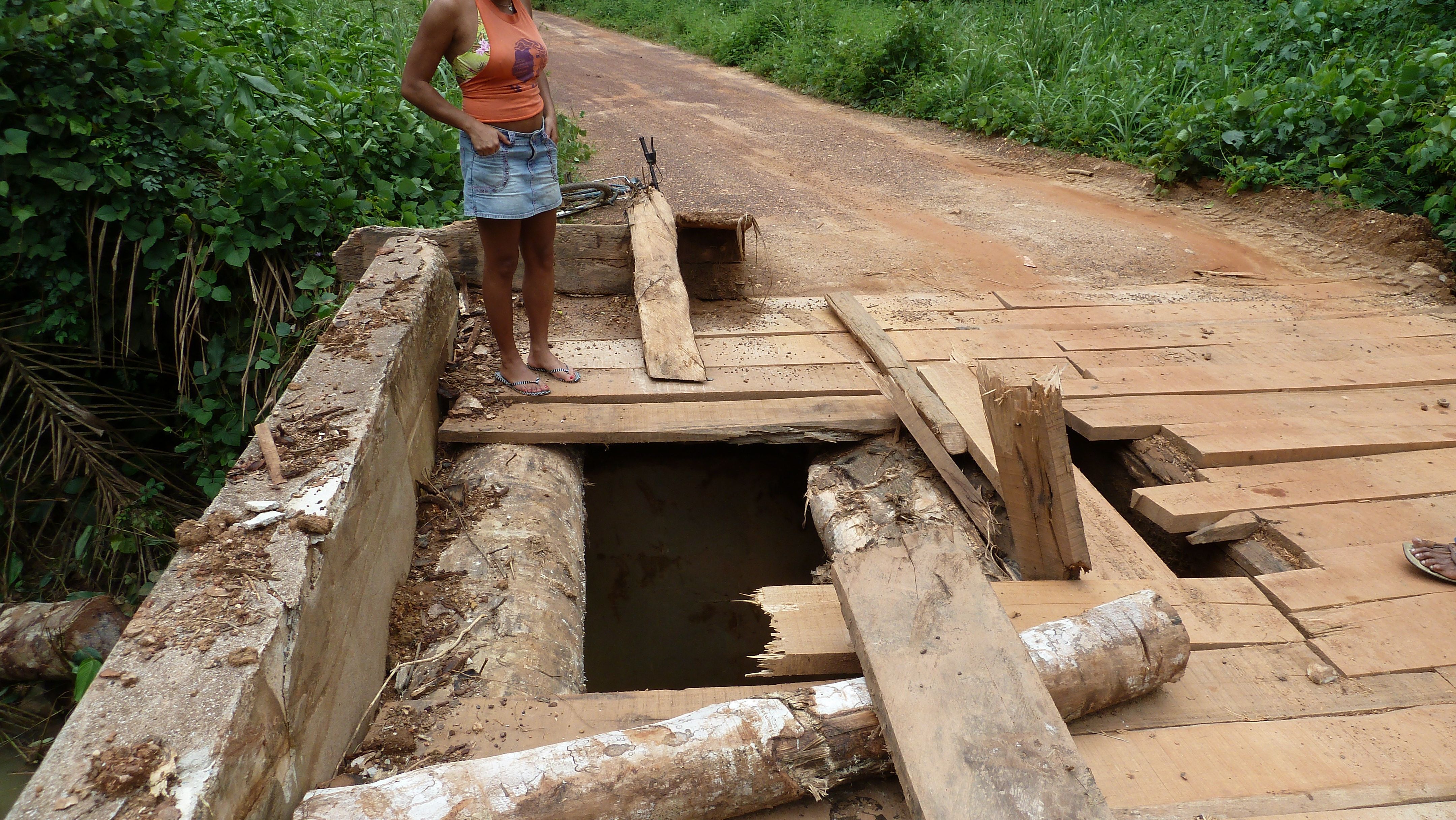
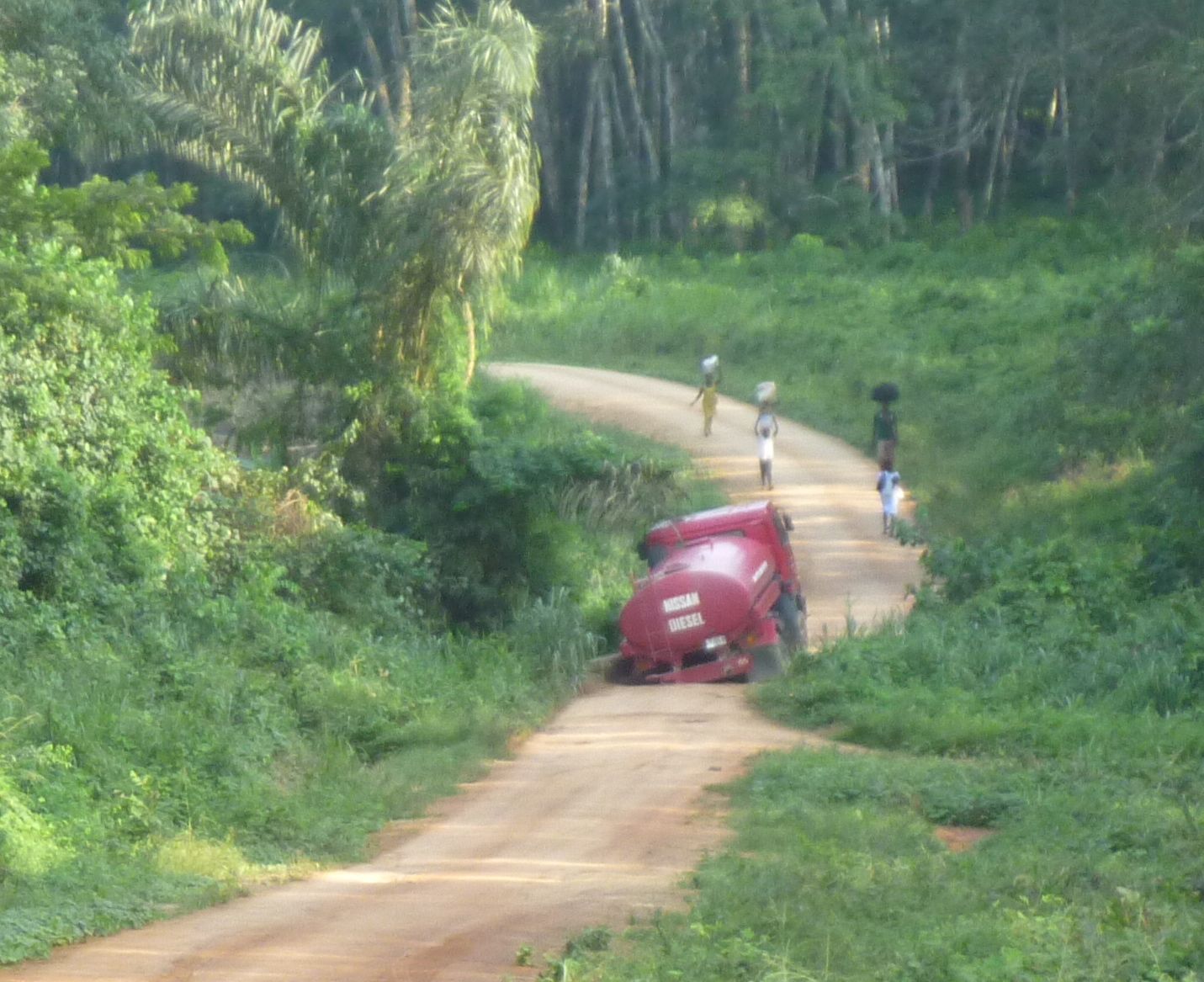
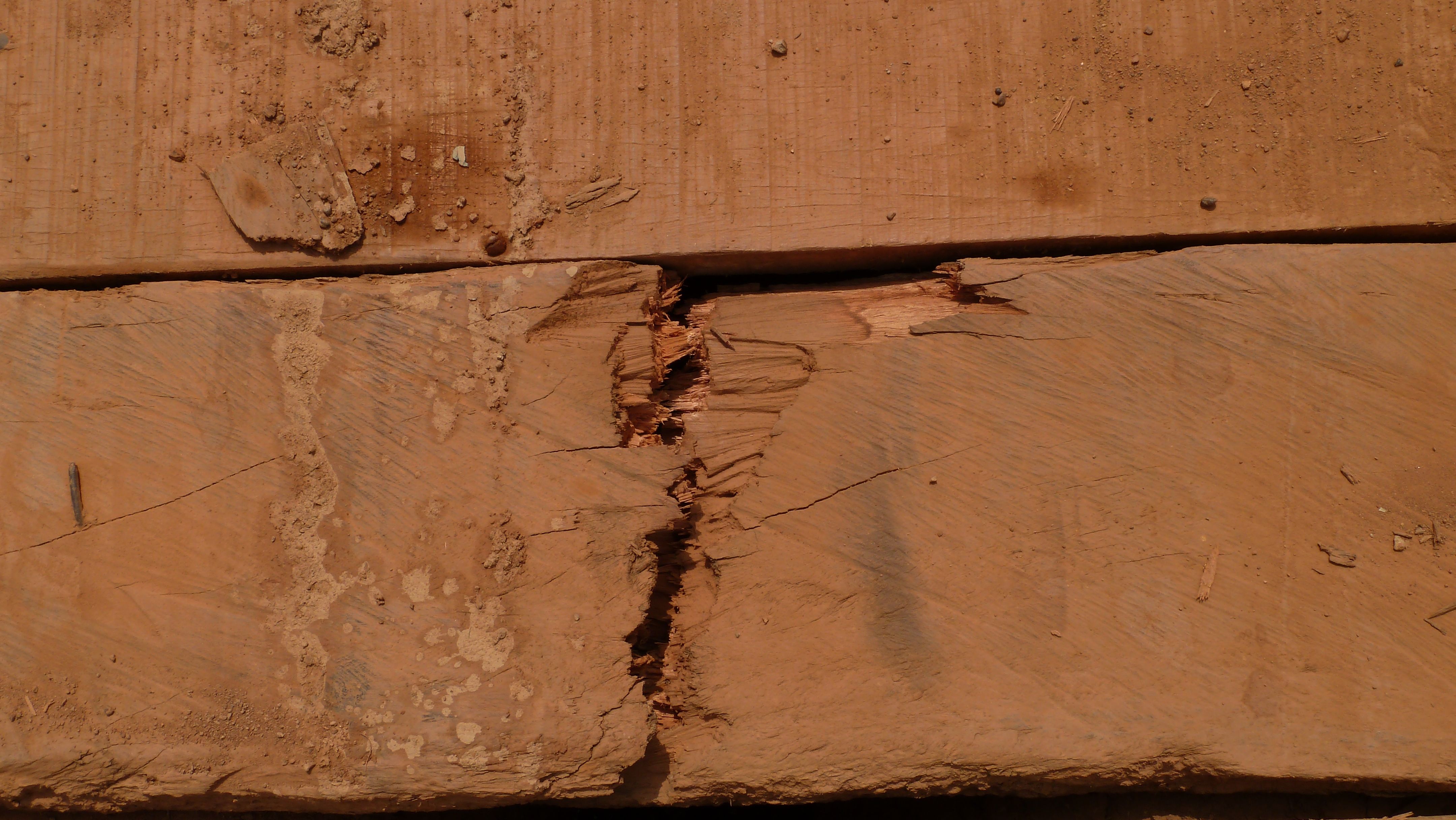
One of these bridges is no more than some logs straddling the banks of the stream with planks placed on top. The planks have given out on several occasions (see photos above and below) and loaded trucks have fallen through, blocking the way until such time as the drivers find a way of getting them back on the road. The bridge is “repaired”, awaiting the next time that it is not capable of withstanding a load that crosses it, and the cycle is repeated.
In a change of policy that is ostensibly intended to support and encourage tourism, the Government of Ghana moved routes which lead to important tourism destinations out of the Feeder Roads category into the Highways category. To date, that has done little to permanently improve to road to Cape Three Points even though the area is home to many tourist attractions including a forest that is unique enough to be categorized for its “Significant World Class Biodiversity”. Word reached the village this week that Highways is coming to grade the road and that will be most welcome, but it does not address the issue of bridges.
Fuel tanker stranded after breaking through the bridge planks… again!
The issue of bridges on the road to Cape Three Points is not a new one. A couple years ago the news media carried a story about a bridge being “destroyed” by displeased youth from one of the villages on that road. The media was not accurate in its portrayal of the circumstances – the bridge did not exist and the youth were doing their best to draw the attention of the public to the sorry state of affairs on their road and others in the area. And in December a delegation of Chiefs from the Western Region met unsuccessfully with Parliament to discuss the need for improved infrastructure, including roads and bridges, for their area.
The time is long overdue for the matter to be addressed in a meaningful way and for proper access be provided for the people and villages in the Cape Three Points area.
December 15th 2010……a great day for Ghana. It was my younger sister’s -nth birthday (her being of a certain age, it would be wrong of me to state which particular birthday). Oh, and it was also the day that (and I quote from the Agricultural Development Bank’s advert in 20th December 2010 edition of the Daily Graphic) “Ghana joined the illustrious band of oil exporting nations….” [my emphasis] Full page, colour advert too!
Illustrious? Does this illustrious band include Nigeria, Venezuela, Sudan, Angola, Gabon, Libya? Nations that… well, in my opinion, although having far greater reserves and having been exporters for far longer are not what I would call illustrious nations in terms of national and personal development.
When one applies for a position, recruiters usually use one’s previous performance as a basis to determine whether one will be able to perform in the future. Based on this premise, I for one will not be celebrating Ghana’s entry into the so-called illustrious band. Why such pessimism?
Although to claim that the offshore oil is “within” Ghana’s western region stretches the imagination a bit (after all 60km out to sea is long way out) the Western Region certainly produces the following:
100% of Ghana’s rubber;
almost the same percentage of Manganese and Bauxite;
55% of Cocoa;
50-55% of Gold;
45% of Timber;
30% of Oil Palm;
30% of Coconut;
10-15% of fish.
Apart from these resources, I think 7 of the 15 historic forts and castles are in this region. Some of the world’s finest beaches are also in the Western Region.
Lets now add 97% of Ghana’s petroleum. What is my point, spouting off all these statistics and numbers?
My point is simple really. Despite all the gold, cocoa etc, etc, the Western Region remains relative to resources GHANA’S most deprived region. Despite having all of the above how has this wealth translated to the well being of the people? Tarkwa, Bibiani, Prestea, all gold mining areas, are some of the most deprived townsites. Agona, centre of the rubber plantations just the same. Enchi, Asankagra, cocoa producing areas, same. In fact the only sustained development in this region was during the governorship of Guggisberg, and even that was purely to ensure that the resources were accessible for export.
Oil will be just the same. President Mills basically said so himself. He is going to do what is necessary BEFORE he will do what is RIGHT! [my emphasis]. What is necessary is to expand the Takoradi Port (ongoing I assume, same with the airport for “oil related operations” and er, that’s it. No improvement in local non oil related infrastructure)
In terms of income, oil will bring in $1bn per annum. As additional income that is welcome, but still some way behind gold, cocoa, international remittances and tourism. Apart from gold most of the supply chain is locally produced and managed. Oil? Nope. Local content bill? – we wait and see.
Festus Tumi publishes the magazine, “Destination Ghana” and the “Ghana Hotel Directory”. He is also a professional photographer.
It is a new year and time for a rant!!! Just before Christmas, I went to Takoradi to buy a few items that were needed to replace faulty components in my hotel.
Call me naive. Call me foolish. But I think that we should all contribute to “Helping Build a Better Ghana”. God knows that I have done my share of collecting and paying taxes for the Government of Ghana since I built the hotel and made the country my permanent home in 2001.
“What happened to bring this on?” you may ask. Well, the week before that trip I asked a friend who has a shop that sells various building supplies if she could supply our hotel a water heater to replace one which is faulty. She offered to have one brought on her next load of supplies from Accra. She called her supplier for the price and I gave her the money in advance. I stopped to pick up the water heater on the appointed date and requested a receipt from my friend, the shop keeper.
My friend and I have had discussions about the VAT before so she knows how I feel about it, but she proceeded to tell me that she could get me a receipt but not a VAT receipt and she would have to get it directly from her supplier. She explained that the supplier would not provide her with a VAT receipt for that item or any of the other items which she had brought from Accra. She went further to tell me that none of the wholesalers in Accra collect or pay VAT. Bottom line – no VAT receipt for my purchase, and no credit to offset the VAT which my hotel collects from all of our guests and submits to the Government of Ghana.
Not good enough for me – I have been down this road too many times. This is an area that you don’t see many folks here talking about and I am going to offer my guess of the reason why. Folks fit into several categories:
1. they live off the land and do not use cash in their day to day living
OR
2. they don’t give any consideration or care about what happens to the country
OR
3. they know that their family and/or friends are dodging the VAT tax and they don’t want to be seen as traitors
OR
4. They are in business and are themselves actively avoiding the collection and payment of the VAT tax
This is not a complete list. The bottom line is this: the VAT tax is not working and a lot of businesses are falling through the cracks in the system. The VAT Service and ultimately the citizens of Ghana lose out in this situation, and so will my friend – I will not be buying from her shop until she starts to conform to the laws of the land.
This happens over and over, every day, in this country. The original VAT is a tax which does not work in this country. It is too complicated for many businesses, whose book keeping is not able to deal with a Value Added Tax. Apparently the VAT Service recognize this problem and that is why they have implemented the VAT “Flat Tax” of 3%. Unfortunately they did not have to courage or the insight to scrap the “value added” idea altogether and change the regime to a straight flat sales tax for everyone, with a lower rate. This would be something that would be much easier for retailers to understand, for consumers to accept, and for the Service to administer. It would also be much fairer to all businesses – at the present time, the hospitality industry is required to collect and submit 15% tax with very few VAT inputs to offset the output, while retailers are allowed to collect and submit only 3% tax. Where is the fairness in that?
2011 is a new year and I for one think that it is time for the Government of Ghana to revisit the VAT system and make it fair for all by changing it to a flat tax and by ensuring that it is enforced uniformly.
Yes, Ghanaian citizenship – that is my resolution for 2011!! After two and a half years, I believe that it is time for the country to decide – will it offer citizenship to me or not?
In the past, I have not taken the practise of New Year’s resolutions seriously. On the rare times that I have set my resolutions, I have done so in private, without disclosing them to anyone. That made it much easier to handle when my resolve faltered because then I was the only one who knew of my failure!
This year, I have decided to go public. I have set my resolve to make this the year that my application for Ghanaian naturalization (citizenship) moves forward to a successful conclusion. I started the process in May of 2007 and completed the various requirements that were requested. From time to time, I have inquired about the status of my application, and always with the same disappointing result. Most recently the people in Immigration say that they have done their work and that the matter now lies with the Minister of Interior. The office of the Minister of Interior says that they have not received the report from Immigration. In other words, a stand off.
Some friends have suggested that a brown envelope containing sufficient financial incentive might be required to get the process moving. Others strongly disagree, pointing out that I have met the requirements and that the Minister of Interior and the Ghana Immigration Service should do the right thing. Still other Ghanaian friends are surprised to learn that I am not already a Ghanaian citizen since my history with the country began almost 40 years ago.
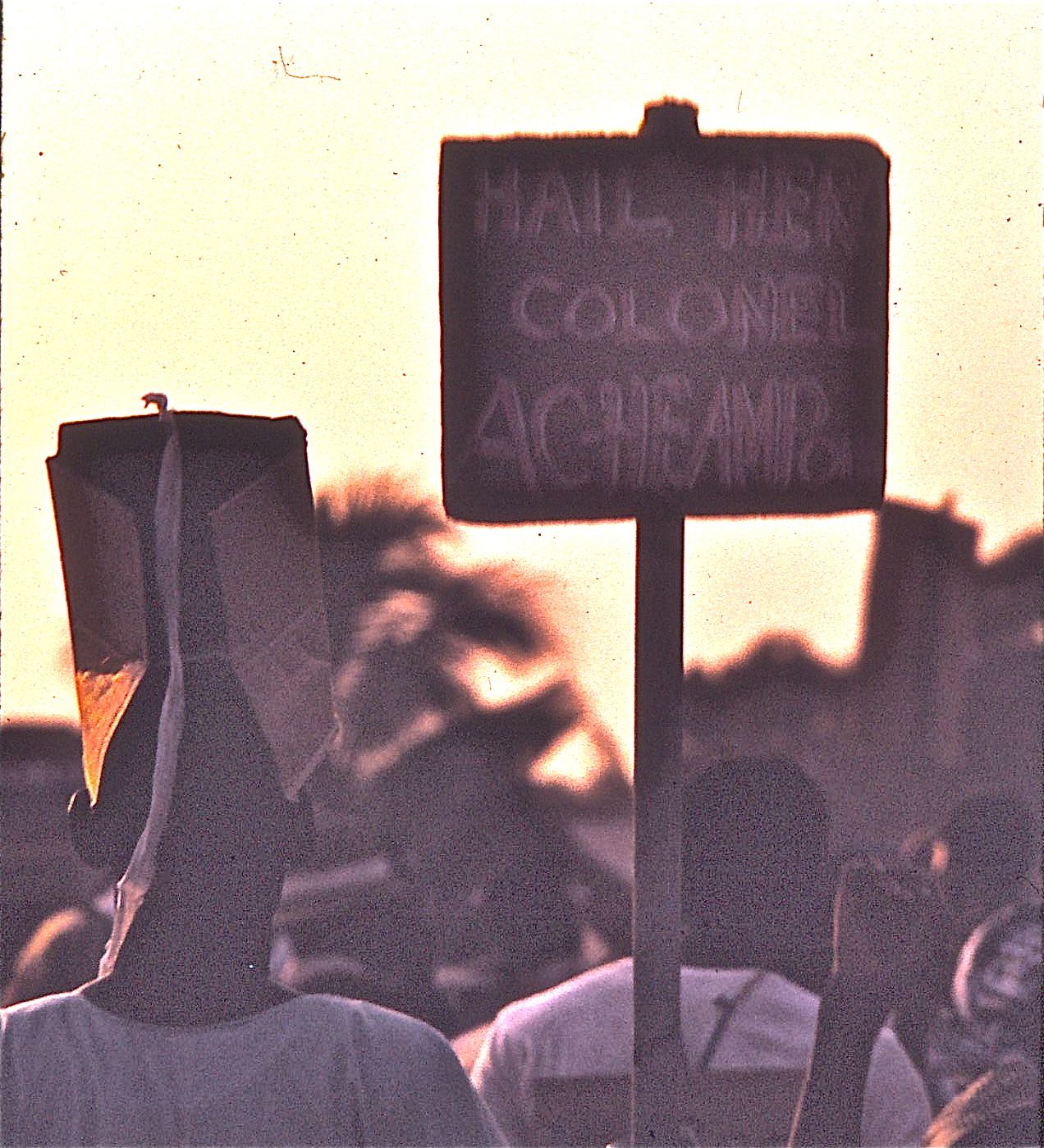
39 years and 4 months – almost two thirds of my lifetime. That is how long it has been since I first stepped foot on Ghanaian soil to take a two year contract teaching in a remote village in the Western Region. During the period of that contract, the country experienced a military coup d’etat and I was here for it.
"Spontaneous" Celebration in Half Assini of Acheampong Coup
It was also at that time that Ghana’s first President, Osagyefo Dr. Kwame Nkrumah died and his body brought back and placed in a crypt in his hometown of Nkroful – I was present and took photos on that occasion also. The majority of Ghanaians today had not even been born yet!!!
Military funeral for Kwame Nkrumah at Nkroful
I was in Ghana for those historic occasions and I am still around. In the nine years since I made Ghana my permanent home, I have been here for more historic occasions, including two peaceful democratic elections; the celebration of 50 years of Ghana’s Independence; the first Africa Cup of Nations; the discovery of offshore oil and the recent First Oil event.
Each country has its history and each of us have our own personal history within that context. It is my hope that 2011 will be a historic year for me – the year that I officially become a citizen of Ghana!!
The annual holiday season is here once again and with it the closing days of another year. I am reminded that it is time to take stock of my life and to be grateful for all of the good that I have experienced in the past year. This is a time of year when it is easy for me to be distracted, whether by the stress or by celebration. It is time for me to remember to stay centred. And that is what I wish for all of my friends and family – that we are able to stay centred in the present as we move into the future of a new year.
(The photograph was taken as sun rose this past Sunday at Cape Three Points, the closest land location to the centre of the world at four degrees latitude and two degrees longitude)
Yes, more hotels for Busua!! Guess someone knows something about the future of tourism that I haven’t learned yet. If more people are investing money in the sector they must have heard that we are soon going to be deluged by tourists, something that we have not seen so far. So that can only mean good things for all of us, right?
Well, aside from the question of economic viability, there are a few concerns that these new hotels raise. If you look at the photos above and below, you will see three hotels under construction. In the foreground is the latest entre into the search for tourism dollars, a partnership of two Italians and a Ghanaian that, according to the contractor, will offer between 13 and 15 rooms.
The roof in the background is for another two storey hotel which faces onto the ocean. Work on it was stopped several years ago by Town and Planning for a lack of building permit. The owner, a Ghanaian living abroad, has returned to Ghana recently and is currently in a tussle with the chief and with Town and Planning as she tries get access from her property to the roadside. Notice that her access, which was already blocked by the electrical pole now will be further limited to a narrow walkway by the new building that is underway.
The third hotel is to the right of the others. Work on it was also stopped several years ago for lack of a building permit. Access to that hotel was also being restricted by other buildings.
Access – something that common sense should instruct developers that is their responsibility to ensure long before a project is undertaken. Access – something that common sense should instruct Town and Planning officers that should be a requirement before any building permit is every issued.
And what about water and sewage? Busua is not serviced by piped water yet and thus relies on shallow wells. Busua village already experiences water shortages during the rainy season in the past and with an increasing population in the village and with added pressure from new hotels, the situation will most certainly become more critical. Water quality will also become a problem, not only from salinization which follows as the water table is depleted but more alarmingly from sewage contamination when septic tanks and their soak-aways are placed in closer and closer proximity to wells.
Does anyone see what I see? Who is taking responsibility for this situation that continues? Would it be so difficult for Town and Planning officers to tell developers that they are not allowed to build their dreams? Are they so strapped for development projects that they are willing to approve anything that comes across their desk? I don’t thing so. Do we feel sorry for developers who blind themselves to the most obvious requirements for such a project? I don’t think so.
There are many of us in the hospitality sector in this Region who have gone through the proper channels when constructing our businesses. We were guided by common sense and by building codes and we worked with authorities to ensure that our structures met requirements, and we should expect that newcomers be subjected to the same guidelines. We count on Town and Planning officers to carry out their duties with proper diligence to ensure that tourism in our communities continues to be a positive force for healthy economic development. We are watching.
In case you are wondering, this is a true story and one with a happy ending, at least for me. Perhaps Mr Johnson, his nephew, the “troublesome Frenchman” and the “Assemblyman” may have a different take on the outcome.
Yes, I was fortunate. I had the benefit of some advance knowledge, given to me several years ago by a very good friend when I was approached with another “too good to be true” proposition. My friend told me then the basic way in which this type of scam works and so I was prepared to deal with it and I pre-empted the way in which it was intended to play out.
Had I not spoiled their fun, these gentlemen would have, with great reluctance I am sure, allowed me to profit from their windfall – but there would have been a catch. Remember the syringe and the liquid which was dispensed into the basin of water? And remember that these sheets each contained four bills attached together? Well, in order to able to separate the bills, my Ivorian friend would have explained to all of us that he required some more of the magic potion in the syringe in order to separate the rest of the bills in the trunk. The syringe contained only enough for one sheet, enough to authenticate the contents, and he had been quick to empty the basin of water and “magic” potion as soon as he had the bills separated.
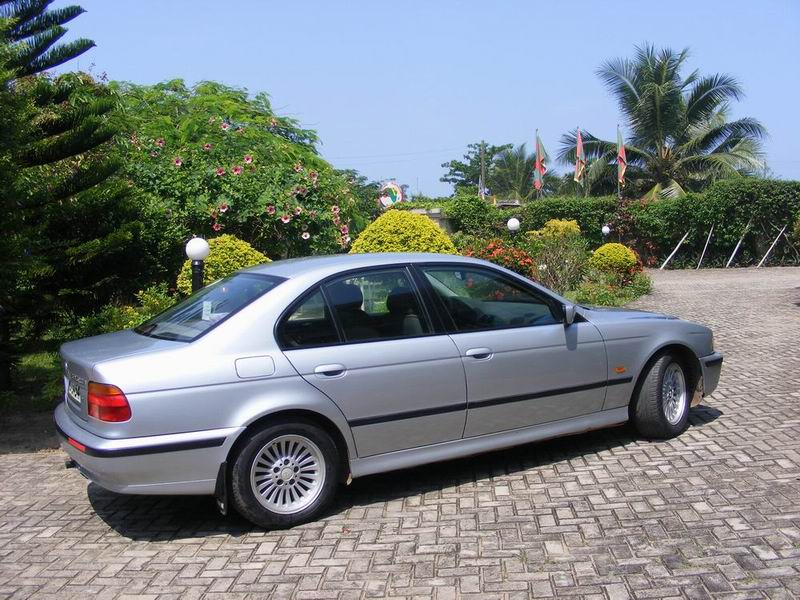
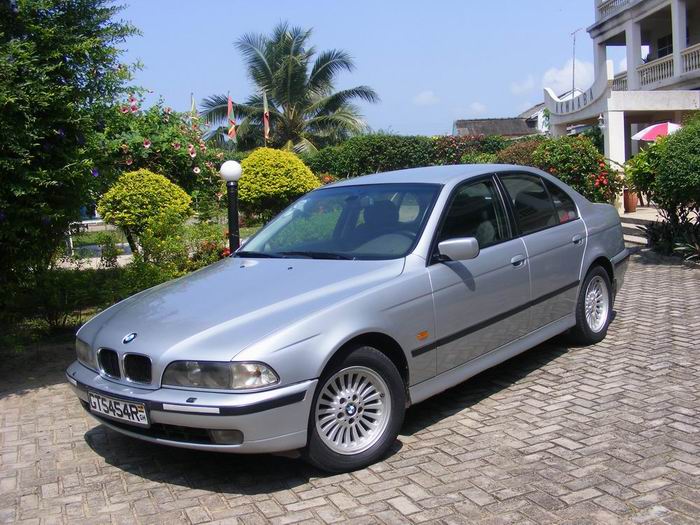
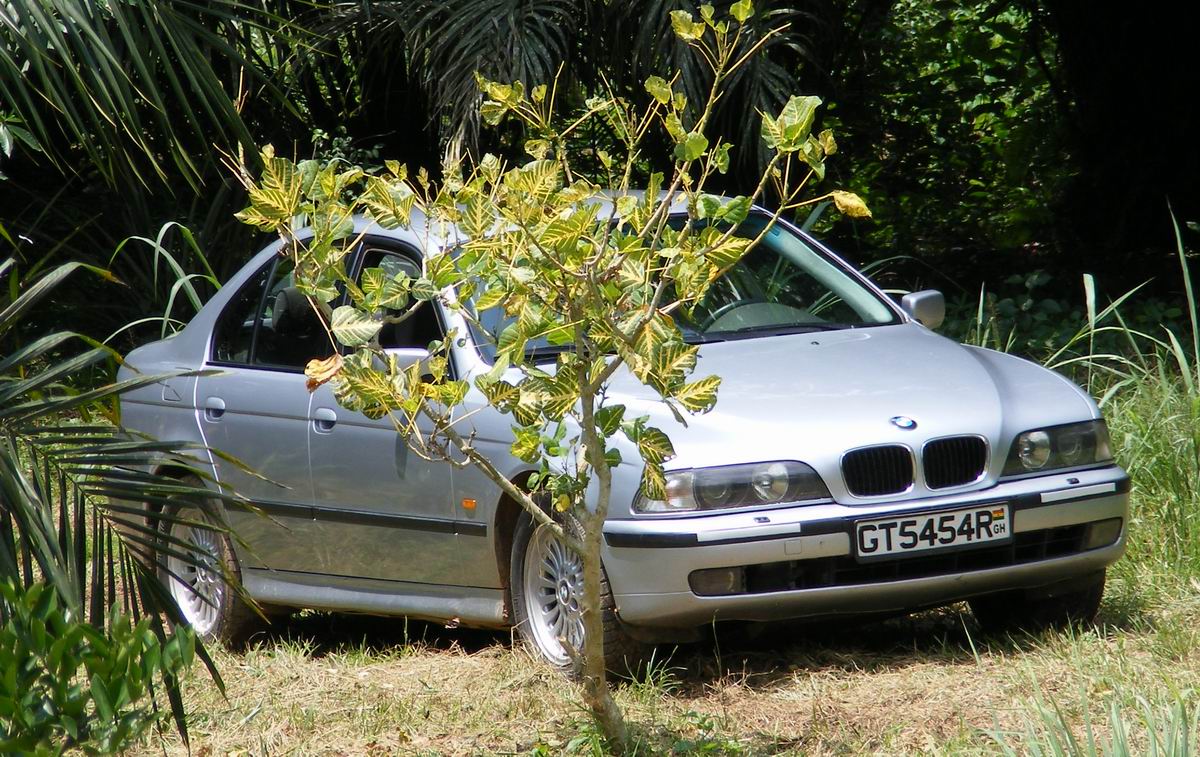
The 8 Million Dollar BMW
In the event that I would have expressed any doubt, the trunk also contained a rather official looking card, laminated, displaying the seal of the American president, and explaining that the contents were a gift from the government of the United States of America to be used to ensure that peace in Africa would prevail. The card further explained the way in which the authenticity of the bills could be determined – i.e. using the contents in the syringe in the way that the Ivorian demonstrated. How could anyone argue with the official stamp of the United States Government, and especially if the “Stars and Stripes” of that powerful country also appeared with it??
And here is where the story would have become more than a story. Only the Ivorian would know where and how to get the potion, and the potion would be expensive. And guess what? The Ivorian would not have the money to buy it. Mr. Johnson and his nephew have already given their money to the Ivorian and so they would also not have any money. However, there would be a solution, one which would enable each of us to get what we wanted. I was anxious to sell my BMW. Mr. Johnson wanted to buy it. My Ivorian friend just wanted to get on with his life. So, if I would help them out with some cash, they would be able to buy the potion, separate the bills and pay me for the car (with separated bills, of course), and everyone would live happily ever after, including the person who supplied the potion who had been paid with my very real money!!
There are other variations on this operation. Sometimes the perpetrators explain that the bills have been marked because they are being sent to be destroyed and all that is needed is to “clean” them with the magic potion. This is the scenario that I had been warned about but as you can see the set-ups can be as varied as imagination permits. The perpetrators look for a likely mark – someone who looks like they are desparate (or greedy) for money. In my case, they could see that I was anxious to sell my car.
The lesson for all of us? If you are presented with a situation that sounds or looks too good to be true, take time to consider it carefully. If you are like me, you try to live your life in such a way as to be open to all possibilities but that does not mean that you throw common sense and good judgement out the window. These kind of scams only work because the victims are willing participants.
By the way, the BMW is still for sale if anyone is interested… Any reasonable offer less than 8 million dollars will be considered.
My Ivorian friend looked at me with hurt in his eyes. “I thought you were my friend.” The nephew handed him a bowl of water, and without saying anything further, the Ivorian pulled a syringe from the trunk, squirted something into the water and all in the same motion plucked one sheet of bills and placed it in the water.
We all watched as he pushed the sheet into the water, and then began to swirl it around and crumple it as it began to soak up moisture. Slowly, one at a time, each of the four bills that made up the sheet began to separate from the others until there were four separate bills.
The Ivorian requested a dry cloth, which the nephew promptly produced from the next room. He pulled the first crumpled sheet from the water, smoothed it out and dried it off, first one side and then the next, as if this was the most natural thing to be doing with money. He handed the sheet to Mr. Johnson, who took his new treasure and began to admire it, holding it up to the light, looking at first one side and then the other.
Soon a second bill was wiped dry and was handed to the nephew, who followed his uncle’s lead, giving this bill the most serious examination. The third bill was dried and handed to me. I had to admit that it had a look of authenticity about it and I wracked my brain to remember the various tell tale signs used to determine a real from a counterfeit bill.
The 8 Million Dollar BMW
I did not put too much effort into remembering. There were other much more compelling reasons for me to question this apparent windfall. Once again, I reminded the nephew that he should be alerting the authorities. However by this time, he and his uncle seemed quite satisfied that they each held in their hands true American bills, each worth one hundred US dollars. “These are real”, Mr Johnson enthused with apparent glee, his nephew nodding in fervant agreement.
It was at that moment that I realized that the Ivorian had accomplices. I rose from my seat, “Well, gentlemen, I think I will be leaving now” I injected. I started for the door, wondering if I would be challenged as I passed in front of the nephew.
“But what about our business? What about the car?” the uncle responded.
“Well, the car is still for sale and if you can bring me cash on a day that we can take it to a bank to guarantee that the money is authentic then we can talk business.”
The uncle expressed his surprise, “What are you saying? Are you saying that we would give you false money?”
“That is not what I am saying at all,” I edged closer to the door and the nephew followed.
“Are you accusing us of being thieves?” he shouted.
By this time I was beside my car and I remembered that I was locked in the compound. I looked over to the watchman, “Wofa, mepa wo kyew, can you open the gate?” As soon as he started towards the gate I was in the car and turning the key. The compound was too small to allow me to turn around. I backed out carefully over the threshold, hoping my car would not get hung up on anything.
Moments later, I was through the gate and on my way out of the back alley, still not willing to look in the mirror because I did not know what I would see. Another hundred yards and I was back onto the paved street and moving away as quickly as the traffic would allow me. The area was unfamiliar to me and I was forced to stop to ask directions, all the while watching the rear view mirror to see if the car with the dealer plates was following. Five minutes and several blocks later, I was breathing easier, relieved to be 8 million dollars the poorer!
Stated as if that was nothing. No big deal. People commonly walk the streets and travel on tro-tros carrying trunks full of cash, right? Well, that has not been my experience, but here I was, looking at a metal trunk filled with stacks of bills that looked very much like one hundred dollar American bills, and I was not about to dispute amount. It was stated with the utmost of confidence and in a way that made it clear that the speaker was not expecting to be challenged on the matter.
Let me try to set the scene. The day earlier I drove my BMW to Accra. The side windows carried “For Sale” signs, with phone numbers – I was hopeful that someone would spot my car and offer to buy it, and in fact several phone calls came in, some more and some less serious in their offers. One of those calls was from a Mr. Johnson. He was travelling in a car with his nephew and spotted the BMW as I neared the outskirts of Accra.
The 8 Million Dollar BMW
Mr. Johnson wanted to check out the car, and suggested that I bring it to him the next day at Kasoa, the sprawling suburb that I had driven through to get to the capital city. The city traffic is notoriously hectic, and I told him that it would not be possible since my business was in the city. Mr. Johnson suggested an alternative – I should meet him in Achimota.
Reluctantly I agreed, even though it was out of my way, because Mr. Johnson expressed a serious interest in the car. The next morning, I drove to Achimota and waited at the Kingsby Hotel, a well known landmark in the area owned by a very good friend. Mr. Johnson’s nephew, a pleasant young man, met me in a car sporting dealer plates, and led me a considerable distance until we turned off the tarred and well travelled streets onto a side street marked with potholes and without the benefit of any bituman to keep the dust down. We next turned into a small alley and stopped in front of steel gates leading into a house compound. After honking his horn to alert the gatekeeper inside, the nephew parked his car outside and motioned me to drive the BMW through the gates, which were then closed behind me.
The yard was quiet. The nephew led me into the main hall of the house where his uncle was sitting in a well padded armchair. I greeted the uncle, who told me that he was Johnson, and he asked me my name. I responded by telling him my stool name, which prompted much laughter – I asked him why he was laughing, and told him in Twi that I am a chief and suggested that he may wish to be more respectful. With that he was more serious, and asked to see the car.
We went back outside. Mr Johnson walked around the car once, asked that I open the bonnet, and once that was done, he glanced briefly at the engine compartment and motioned that I close the bonnet. He started to lead us back to the house, when something seemed to attract his attention outside the compound wall. “Oh, there is that troublesome Frenchman,” he said. The head of a man who was apparently quite tall was visible above the high walk-in gate, and the nephew went over to talk to him while his uncle and I returned to the hall.
Almost immediately, the “troublesome Frenchman” was in the room with us, a very big black man with tribal marks on his face which showed he was not from the local area. The uncle and nephew asked if I spoke French, and when I indicated no, they began to tell me the story about this new visitor.
They told me that they had met him three days earlier at the town of Elubo, the western border crossing to Cote d’Ivoire. They told me that he was having difficulty clearing a trunk through Customs, and they assisted him by loaning him $3,000 to pay the Ghana Customs officials. He told them that the trunk contained jewelry which he was bringing to sell in Accra. When they arrived in Accra, they kept the trunk while their new Ivorian friend went off to get the money to repay them. He was now before us, begging the uncle and nephew to release the trunk so that he could take it and sell the goods to an interested party, which would then enable him to repay them the money that they had loaned him.
Mr Johnson was quite adamnant – he was not letting the trunk go without the money being repaid. I suggested to the “Frenchman” that he bring his customers to the house so that they could buy the goods there. He said it was not possible, and then he asked me to beg on his behalf to have the trunk released. I reminded him that I did not know him, nor did I know the other two men in the room. He than asked to speak to me outside.
We stepped out onto the small veranda that led off the front door. Once out of the earshot of the other two, he confided in me that the trunk did not contain jewelry as he had told them. He explained that that is the reason that he could not bring his customers to the house. “So, what is in the trunk?” I asked him.
“Money,” was the reply, “not jewelry.”
“So there is no problem. If there is money in the trunk, why don’t you open it now, pay them what you owe them, and be on your way?”
“I don’t know these men and I have no witness. Unless you can be my witness…” he looked at me with mournful eyes, desparate for my assistance in this grave matter.
Of course, I just wanted to get on with my own business – to find out how serious about my BMW Mr. Johnson was, and move ahead with the rest of my day. I agreed, and my Ivorian friend seemed relieved. We went back inside.
I returned to my seat while my friend stood, waiting for me to explain our new proposal. “If you bring out the trunk, my friend will pay you your money”, I said.
The nephew immediately reponded “What does he take us for? Does he think we are fools? We are not going to give him his trunk until he gives us his money.” The uncle nodded in agreement.
The nephew continued to protest but I cut him off. “Abotre [patience], my friend, abotre. Just bring the trunk and let the man open it and he says he will pay you the money.”
The nephew continued to mutter his disagreement but went into an adjoining room and returned, carrying a box covered in brown wrapping paper. It appeared to be quite heavy and he struggled as he set it down in the middle of the room. The Ivorian began to carefully undo the paper but the nephew impatiently pushed him aside and ripped it off, exposing a grey metal trunk of the type often used by students to store their personal belongings when they are attending boarding school. The Ivorian produced keys and unlocked two padlocks that secured the trunk, and opened the lid.
Mr. Johnson leaned forward and then let out a gasp, “Oh, my God!” he exclaimed. The nephew also leaned forward from the other side with a similar response. The lid of the trunk still obsured my vision, forcing me to also lean forward to peer inside.
Of course I had the advantage of being warned of the contents and so I just smiled at what I was looking at – neatly stacked piles filled the trunk, leaving no space, and each pile consisted of sheets of bills, four crisp one hundred dollar American bills in each sheet. The nephew became quite agitated. “We should call the Assemblyman.” As if to reinforce the idea, he repeated it, “We should call the Assemblyman.”
The Ivorian, with a serious look on his face as if it were quite normal to see a trunk filled with money, asked for a bowl of water to be brought to the room.
As the nephew scurried out to fetch the bowl, I turned to Mr. Johnson. “My friend, you should immediately phone the police. This is a scam, a 419. You must call the police immediately.”
My hotel is located on the coast of Ghana and there was a time not so long ago that visitors came to our dining room because they knew that they could enjoy fresh fish from the ocean. That is no longer the case. The reason? because WE OFTEN CANNOT BUY FRESH FISH!!!! This is not for a lack of trying. The local fishermen go out every day in the hopes that they will bring back something to feed their families plus some fish to sell for cash. Often they return empty handed.
And yet what do we see along the coast? Here at Busua? At Akwadae? At Cape Three Points? At Axim? At Beyin? At Half Assini?
Foreign fishing trawlers, working close to shore, in an area in which they have been forbidden…. I have seen these foreign trawlers frequently, and I have never seen a vessel from the Ghanaian navy challenge them. When will it end? When ALL of the fish are gone?