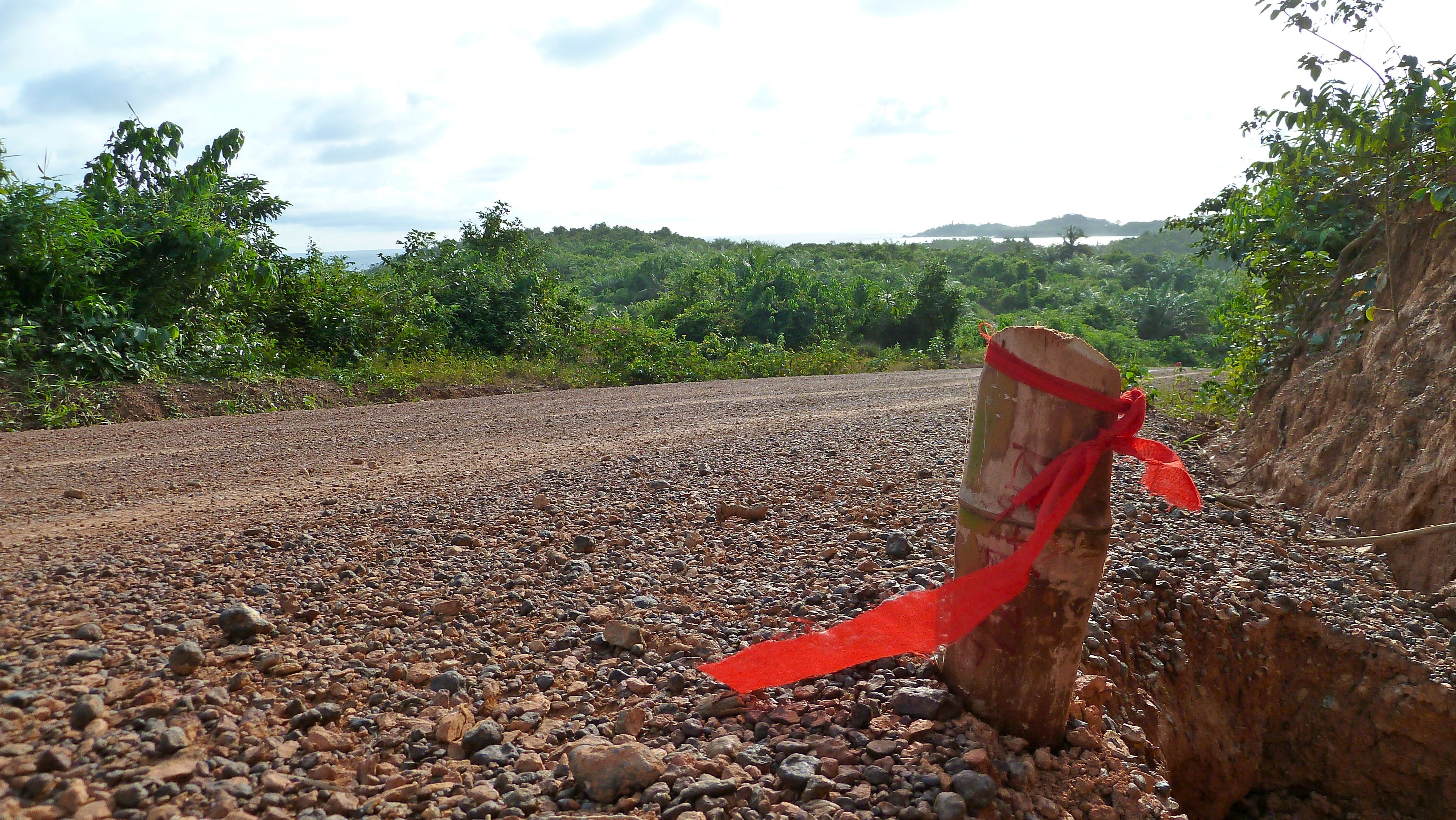
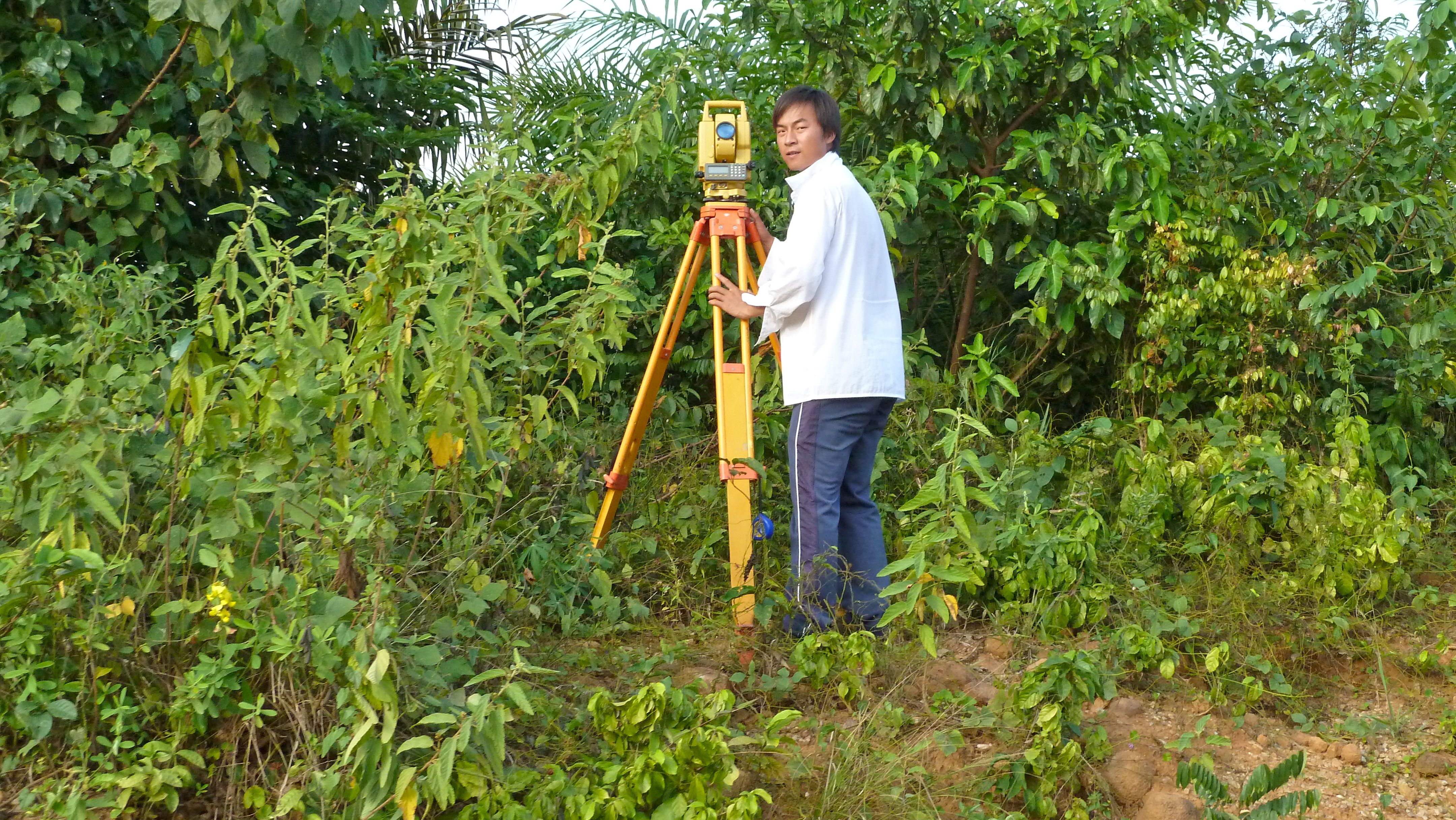
Yesterday I returned from Cape Three Points. While I was there, I visited the palace. After greeting the chief, I asked him about the survey markers that I had seen on the road leading to the village. The information that he had been given is that a coastal road, first conceived by Dr. Kwame Nkrumah and stretching from Dixcove all the way to Jewi Wharf, will be constructed by a Chinese contractor. I snapped one of the surveyors on my return – see the next photo. I was subsequently told that a Korean contractor has been given the job. I wonder what the real situation is? Stay tuned – I hope to meet with the Ahanta West District Chief Executive to see if he can shed some light on the situation.
Several questions run through my mind. Considering the multitude of lagoons that mark this stretch of coastline, what is the projected costs, both financial and environmental, of such a proposed road? Anyone who is familiar with this part of the country will ask the same question. Who is funding this project? What is the real purpose of such a road? What is the time frame? How does this relate to the 2012 election?
This surveyor was spotted working on the road between Akwadae and Cape Three Points yesterday.
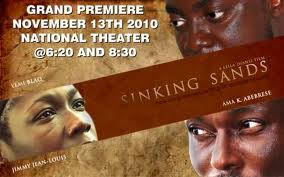
Director Leila Djansi has raised the cross bar to a much higher standard for producers and directors in the Ghanaian movie industry. The movie going public no longer has to settle for the mind numbing mediocrity that has characterized Nollywood products for so long. Djansi’s psycho-drama, “Sinking Sands,” attacks the difficult social topic of spousal abuse in a very direct fashion. On Saturday evening this left the audience at the VIP Special Viewing uncertain and uncomfortable in their response.
The movie begins by depicting ordinary everyday village life and then proceeds to demonstrate the effects of spousal abuse in very graphic form. Members of the audience recognized themselves or close loved ones as perpetrators and/or victims and they responded with nervous twitters at inappropriate times to intensely dramatic scenes. Director Djansi had succeeded to move her audience.
Djansi wrote the script and directed and produced the movie, shooting it all in Ghana with a predominantly Ghanaian cast and crew. Well known television personality, Ama K. Abebrese, and actor Jimmy Jean-Louis are in starring roles. This movie will inspire all Ghanaians who are interested in reviving the Ghanaian film industry – “Sinking Sands” demonstrates clearly that Ghana can produce a world class product. “Sinking Sands” premieres at the National Theatre this Saturday, November 13. Be sure that you are there.
Nana Amoako Agyeman presents his poem “Are You Offended by My Music?” during Ehalakasa Mega Fiesta 2010 on the Main Stage at Alliance Francaise Accra, backed up by United African Spirit, the Rooftop band of the African Rainbow Resort in Busua.
Ehalakasa Mega Fiesta 2010 featured poetry and music on the Main Stage of Alliance Francaise Accra. Nana Amoako Agyeman presents his poem “Just a Country Boy”, accompanied by the Rooftop band from the African Rainbow Resort in Busua, United African Spirit.
This past Saturday, I sat in the backed up traffic somewhere between Mallam Junction and Keneshie Market in Accra, edging my way one car length at a time along with everyone else who was intent on leaving the capital. Somewhere behind us, I could hear the wail of a siren and along with my fellow travellers, we all tried our best to move to the side to make way for the emergency vehicle that we thought was desperately trying to make its way through. There was very little room to maneuverer in the cramped conditions and even after our best efforts there were only a few feet between my car and the taxi beside me.
Suddenly a police motorcycle was beside us, weaving his way between the crush, followed abruptly by a second one. The rider of the second one reached out and with obvious intent smashed the mirror off the taxi, waving his fist and directing some deleterious comment towards the hapless taxi driver who sat defenceless as he watched his mirror soaring through the air before crashing to the pavement and smashing into pieces.
My passengers and I had not even had time to vent our outrage at the unnecessary actions of this policeman when a cavalcade of six shiny black Toyota LandCruisers sped by, each emblazoned with the logo of CARE International, the passengers comfortably hidden behind air conditioned smoked glass and oblivious of the threat to everyone’s safety that they were causing and quite obviously un-CAREing about the plight of the taxi driver whose car had just been damaged.
After they had passed, the driver retrieved the remains of his mirror, and we all continued to shuffle our way towards the edge of the city. The officials of CARE International presumable were off somewhere to “defend dignity” and to “fight poverty” while the rest of us were left to live our real lives to the best of our ability, without the benefit of a police escort to take us through the chocked traffic that is so much a part of the daily grind of Ghanaians who reside in Accra.
The actions by this organization are not surprising to most citizens in this country and the 69 others in which it operates, but it should give cause for concern to those people overseas who make donations to CARE. In 2009, the total contributions totaled in excess of US$700,000,000. Somewhere in the zeros, this organization has lost respect for the people that they say they are out to assist. Apparently with all those zeros, their time is much more valuable than that of the rest of us.
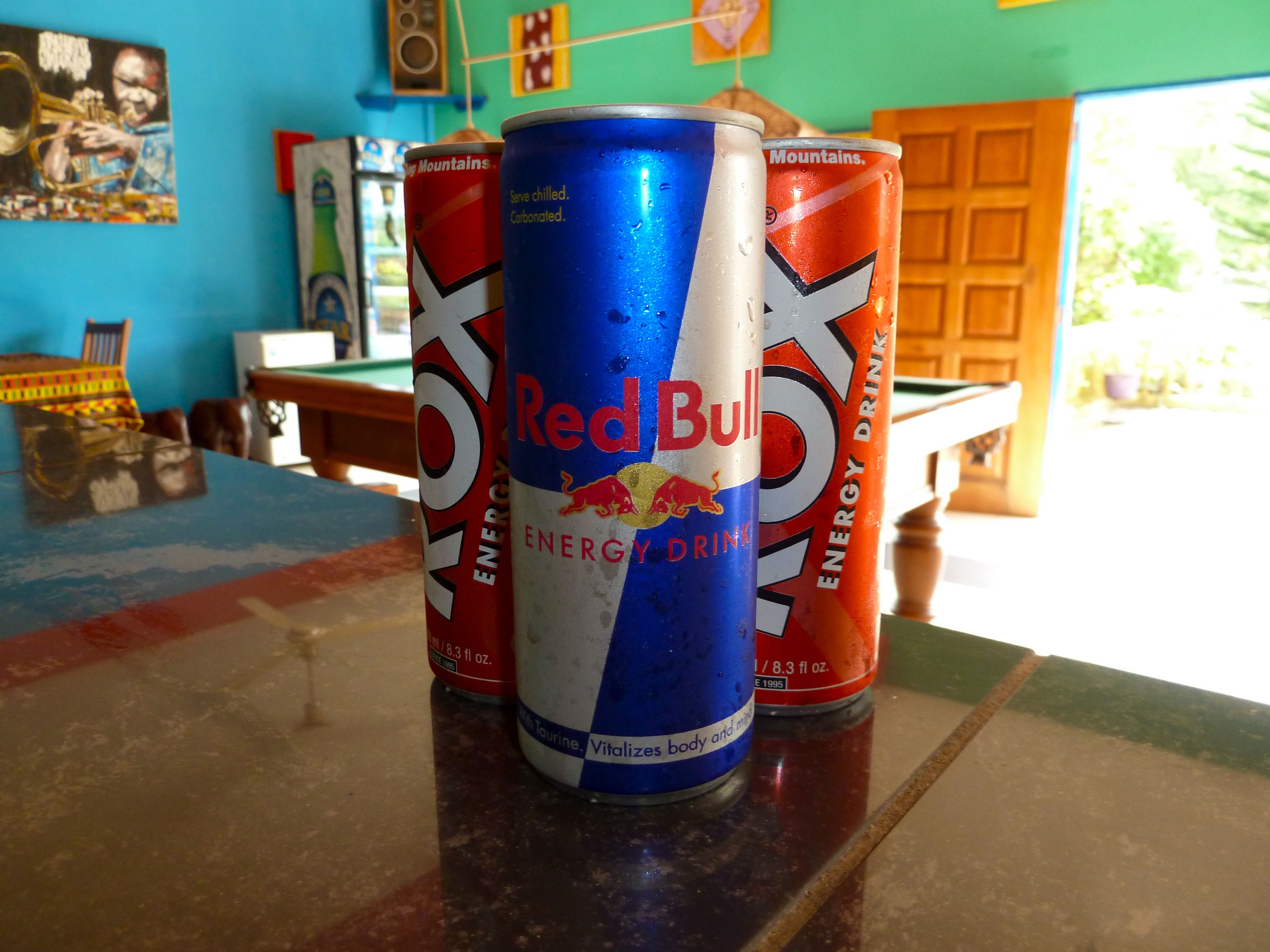
I was recently sitting with a friend at one of Accra’s landmark spots enjoying a cold beer and catching up on recent events in our lives. One of the illuminated signs over the bar stuck in my mind and set me to thinking the following day. The sign was promoting the well-known Red Bull energy drink, enjoyed by many, I am told, who wish to “enhance” the effects of the alcoholic beverage that they are consuming. My interest was not so much in the drink but rather of the aluminum can in which the drink is contained.
The popularity of the drink, and the very can itself, are a mockery of this country – a country, rich in bauxite but one that relies on outside sources for its aluminum requirements. Even now, Ghanaian bauxite that could be so easily turned into cans to contain the “energy drink” consumed by countless Ghanaians is shipped from Takoradi to be refined somewhere else in the world, in one of those bitter ironies of this modern capitalist age. At one time, Ghana provided cheap electricity to refine someone else’s bauxite, and now when the country could benefit significantly from refining its own resources, the economic “masters” of the world have found a cheaper source of electricity than ours to do that job. Once again, the economic interests of Ghana and Ghanaians have been sacrificed for the economic benefit of foreign corporations.
How many know the story? A tale of the economic colonizer convincing a newly “independent” country to construct a dam, a dam that flooded a vast area of agricultural land and destroyed forests which contained valuable timber resources and once provided the ingredients for traditional medicines to keep the nearby inhabitants healthy. The story of promises that the rich bauxite resources of the country would be refined here, and thus create an industrial base for the further economic development of the country.
Instead, what happened? Well, the dam was constructed, with loans from willing “donor” nations thus putting the county into debt and subjecting it’s government to outside financial controls. Contracts were signed to guarantee that cheap electricity would be used to refine bauxite but instead of extracting the ore from Ghana, it was brought in from the mines of some other hungry country, leaving Ghanaian bauxite in the ground for many more years.
The initial contracts guaranteed cheap electricity rates for just long enough for the economic colonizer to maximize its profits, and then, with turbines worn out and silted up and in need of expensive refurbishment, they abandoned the ship and moved on to other greener pastures.
Meanwhile other economic colonizers have stepped up to the plate, more than willing to continue the plunder of the country. The bauxite resources were still an attraction, and so they were brought out of the ground and sent outside to be refined. The country continued to aid in its own exploitation. The rail system which was built by the political colonizer was for a time used to transport the ore to the harbour but it soon fell into disrepair. So the ore is now transported by a large fleet of multi-axle truck trailers using the road system, further contributing to environmental global warming and also adding substantial wear and tear on an already overstressed highway system – a system which in turn the “independent” government borrows money to rebuild, once again, placing itself in debt and under the control of outside financial sources.
And the cycle repeats itself…. How addictive an “energy” drink becomes. The energy of a people and their resources – addicted to continued and continual control by outside economic colonizers.
The insistant drone of the first call to prayer for the faithful assured me that I had returned home to Ghana. Shortly after that, early bird songs outside my window reminded me why I chose this lovely place in Accra as my base for the first days back. Bibie Brew’s New Morning Arts Cafe in Tesano is a an oasis of calm within the hustle and bustle of this city of six million souls, all striving to improve their hold on life, and each chasing their own dreams and avoiding their own devils.
I returned last week from a four month visit to Canada. While there I found myself reacting to a way of life to which I have become unaccustomed since my relocation to Ghana. Oversize pick-up trucks and overstocked “super” stores can be overwhelming for someone much more at home in a small village that relies on a few small kiosks and local women selling vegetables or fruit from wooden tables for most of its daily consumables.
I have returned and I was reassured of my return to the familiar with an event that occurred within moments of my arrival – the lights went out and the luggage carousel ground to a halt in the arrivals hall at Kotoko International Airport. I looked over at one of my fellow passengers, a Ghanaian woman returning to visit family, as we waited for the electricity to come back on and we exchanged knowing smiles. I could not help but comment “welcome back to Ghana”.
This post will go up on my blog as soon as MTN is able to repair their connectivity – apparently they have had their own “problems” since last weekend, just prior to my return. But, no worries – this post and my blog are not all important and this “problem”, like the brief lights off delay at the airport are just reminders that “quality of life” should not be measured by how well “things” work but rather by the way people interact with each other.
I recall the comments from a friend of mine a few years ago when he was “out” to visit his daughter in Montreal. He remarked during his first few days there that it was such a pleasure because “everything works”. Some time later, he was expressing how much he missed Ghana – he was no longer so enraptured by the smooth running systems that he saw in North America – the electricity that was reliably on all the time; the smooth flow of traffic on well maintained streets; the prompt and courteous service at the fast food counters; the professional and uncorrupted conduct by civil servants. He was bored, and looking forward to his return to Ghana.
As I say, there is much more to life than the “stuff” that western commerce offers us. Last Monday afternoon at the airport, the uniformed woman in the Immigration booth flashed me a welcome smile as she stamped my passport and handed it back to me. I exchanged some good natured bantering with the Customs official and he shook my hand and said with a grin, “Akwaaba, Nana” and I was on my way out to the taxi stand with my new driver friend, John. In each of these interactions, as brief as they were, we acknowledged our common humanity and that is something much more important than any “problems” we may encounter with “stuff”.
I enjoyed my four month visit to Canada – it is always great to reconnect with family and good friends, and the memories of my time will remain with me as I go about my life here. A break in routine is always good, but it is good to be once more back Home Sweet Home.
Today at New Morning Arts Cafe, Tesano. New Words for a New Earth. Don’t miss it. Golda Ado and Bibie Brew and their amazing crew, talking and singing and acting and sharing to show us how we can all make a better world for all of us and for generations to come. New Morning – New Earth Day!!
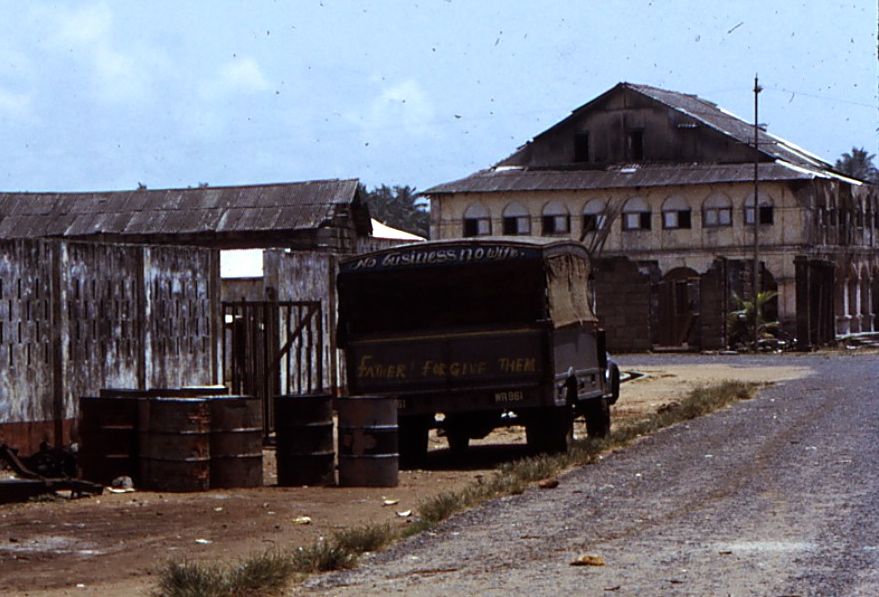
Was this lorry owner in Half Assini (1973) publicly acknowedging his own responsibilities, or was he counseling others what would happen if they did not live up to theirs? Ghanaian women rarely tolerate husbands who are not capable of supporting their families, as this lorry testifies.
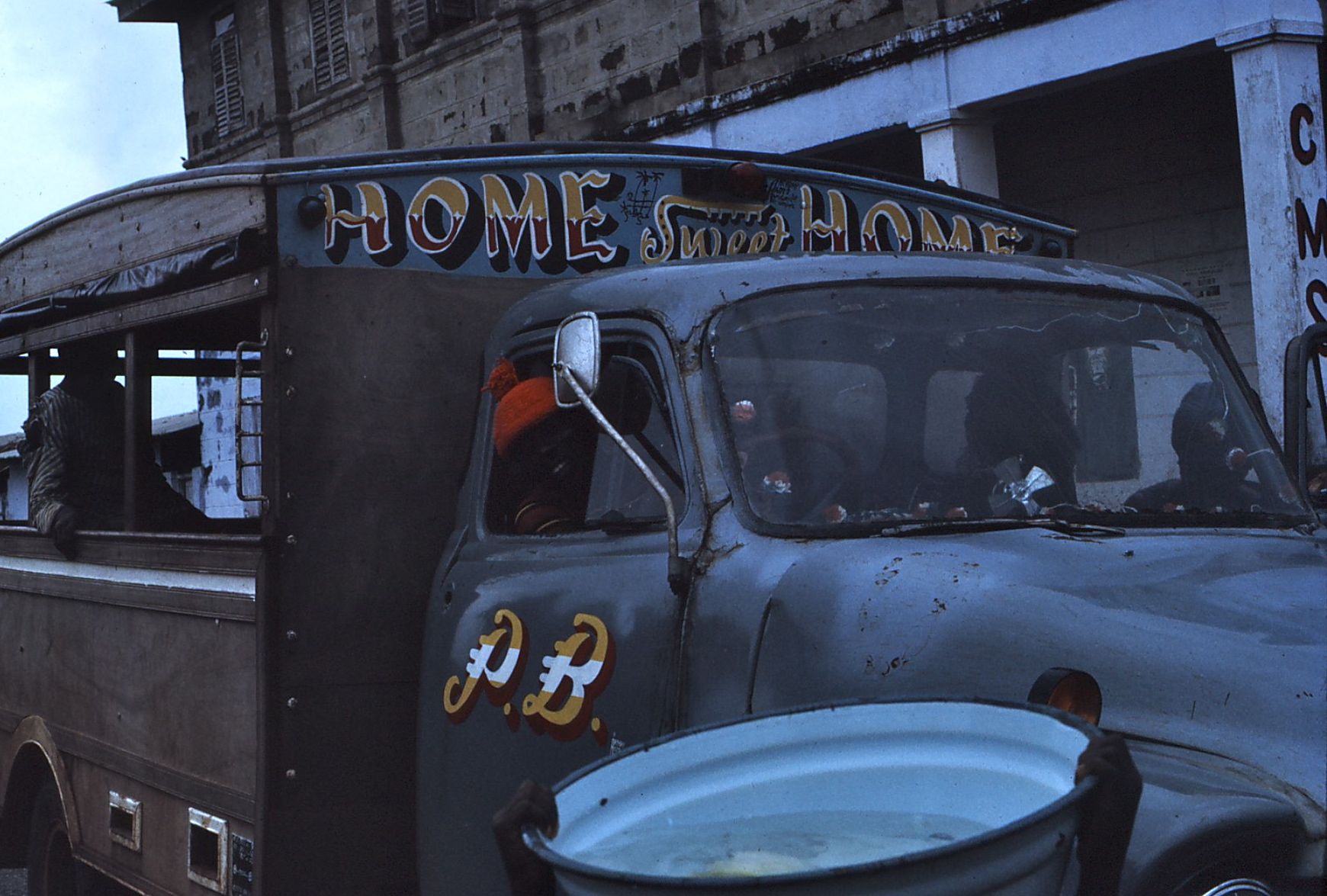
It is said that home is where the heart is. In 1973 when I took this photo, I thought of Canada as my home. Times change, and now, almost 40 years later, it is Ghana that I think of as “Home, Sweet Home.”