My life has led me down different paths. Each has brought its own blessing. This is my way of sharing some of them.

  • CAN’T SEE THE FOREST FOR THE TREES

    School children with trees after one year of growth
    School children with trees after one year of growth

    During a recent visit to my oil palm farm at Kwame Adjei in the Ashanti Region, I was able to check on what you might refer to as  a long term project – my “timber plantation”.

    Allow me to explain. About the time that I was buying the farm in 2004, a Quebec based nursery company had been commissioned by the Forestry Department to demonstrate an improved method of starting nursery stock used in reforestation in Ghana. In a serendipitous meeting at our hotel, the African Rainbow Resort, we met the expert who was overseeing the project, Claudine Ethier. Claudine described her work, which was very fascinating, and spoke about the potential for communities to become involved in nursery and reforestation projects.

    The project was coming to an end, and Claudine told me that a number of seedlings had been started and were likely to be discarded. I offered to take them off her hands and she was pleased to see the seedlings planted rather than have all of that effort wasted.

    Comfort and I drove our pickup one day to the nursery near Kumasi and in two trips we were able to collect almost 1,200 seedlings. The first 60 seedlings were taken to the Primary School in Comfort’s home village, Amudurasi. The children planted them in a row between one of the classroom blocks and the highway. Within 24 months, the tallest of these was more than 25 feet tall!!!

    The remaining seedlings were transported to my farm. I hired four men from Amudurasi to go with me. These were all men who are accustomed to the arduous work of clearing bush in

    A cederella which has grown through the canopy
    A cederella which has grown through the canopy

    preparation for farming. Within a period of a week, they had managed to cut paths through the dense undergrowth to enable the seedlings to be planted. The majority were planted in four rows along one side of the farm, with two rows around much of the remaining perimeter of the farm. Within several months the first rains had come and the pathways that had been cleared were overgrown again but the species are adapted to such conditions and will eventually grow through the canopy and in time they

    This is the forest that it grew through
    This is the forest that it grew through

    will tower above it.

    In thirty years, these trees will be approaching a size large enough to begin harvesting them for timber. Many of the local inhabitants questioned the economic wisdom of planting something which would require more than thirty years before it could be harvested, especially considering that the man who was doing the planting would not likely be the one who was going to benefit from the harvest. I have not been too bothered by those concerns.

    Planting trees was part of my upbringing on my father’s farm. As a child, I played on maple trees that had been planted by my grandfather shortly after he and his father homesteaded. I remember accompanying my Grandfather as he drove a horse drawn cultivator in the shelter belts that he and my father had planted on that farm before I was born. As a teenager, I helped my father and mother and brothers when we planted even more tree belts. And when Comfort and I bought our farm a number of years later, one of the first things we did was plant rows of trees around the farm yard.
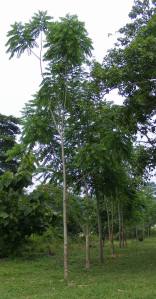
    The trees at the school yard - 4 years of growth
    The trees at the school yard – 4 years of growth

    I guess you could say that planting trees has just been a part of my life. Planting trees in Africa is just a continuation of my previous life, and with global warming almost a buzz word these days, I am sure that I have not yet planted my last one!
  • ASANTEHENE’S ANNIVERSARY CELEBRATION

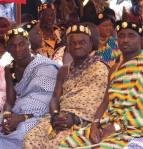
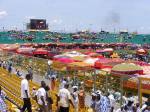
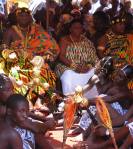
    On Sunday, April 26 in Kumasi, many hundreds of Ashanti chiefs, their elders and their supporters assembled at the Baba Yara Sports Stadium to pay homage to Otumfuo Osei Tutu II, the King of the Ashanti Nation and to celebrate the tenth anniversary of his enstoolment on the Golden Stool. I was one of the chiefs, now a participant in an event instead of being an observer. The change in roles brings with it a much different perspective.

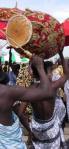
    Five years ago, my wife and one of our daughters and I sat in the bleachers of that same stadium with the thousands of people who came out to witness and offer support through their presence when the fifth anniversary was celebrated. From that vantage point we could watch as the Omanhene entered under their brightly coloured durbar umbrellas, attended and surrounded by Queen Mothers and lower chiefs and supported by drummers beating out their encouragement and horn blowers offering their praises.

    On Sunday morning, the Edubiase Division of the Adansi State made our way to Kumasi. We entered the stadium through the entrance designated for the chiefs. In a crush of umbrellas and drums and humanity, with okyeame juggling for the best position for their chiefs and followers, the chiefs pushed their way into the stadium. The air was filled with a sense of excitement and expectation, in anticipation of the spectacle that we had all knew was about to unfold.

    The Stadium holds 50,000 people – the crowd was large, made up of the King’s subjects plus Ghanaians from other parts of Ghana and foreign visitors and dignitaries, seated in the bleachers around the stadium. The various paramount chiefs and divisions of the Ashanti were assembled on the playing field in designated areas. Seating was at a premium and late comers were sent scuttling around for chairs and when successful in finding them, had to jockey for room to place them.

    Rains had come earlier in the week, leaving clear blue skies out which the sun beat down on those unable to sit under an umbrella. In spite of the heat, the assembled crowd showed no sign of leaving until the last speech had been delivered.

    Large spectacles are difficult to capture in their entirety. The selected photos provide slices of the whole and a sense of the event.

  • THE GREAT WALL

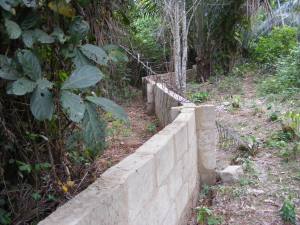
    The Great Wall

    Land litigation is almost a way of life for some folks in Ghana. Even when one is not looking for a quarrel, disputes seem almost inevitable for anyone who has land holdings in the country. My wife and I have experienced our share of these challenges, beginning almost the first week in 2001 that we began building our hotel. One of the parishioners from the community tried (unsuccessfully) to question the boundary which we share with the Methodist Church.

    That encounter was short lived. Fortunately, Comfort had been given some excellent advice three years earlier when we purchased the land. Before she and our daughter returned to Canada that year, she had a cement block wall constructed around the perimeter. The wall was only eighteen inches tall but that was enough to prevent anyone from encroaching and then using the excuse that they did not know where the boundary was supposed to go.

    Our experiences since that time would fill several blog entries, and for Ghanaians who are versed on the subject, these entries would begin to sound too much like déjà vu. They include encroachment by road contractors and by municipal authorities. On more than one occasion, the person who sold the land has continued to occupy and use the land, or attempt to use the land, almost as if they had forgotten that they no longer owned it. Land that has been held in families and subsequently sold by one member is also up for debate when a different person in the family decides that they had not agreed to the sale.

    Most recently, and perhaps most distressingly, we have found ourselves in a situation where a portion of family land held for three generations, with a site plan stamped and signed by the chief, has been sold to another party by the very chief who signed the earlier document. By tradition, a chief has the right to re-enter land which has been leased to someone, however Ghanaian law has set out the correct procedure for this re-entry and for compensation to be made to the party who loses the land.

    Unfortunately, this procedure is often not followed, and land is taken without consultation or compensation. These actions are rarely challenged, often out of ignorance of the law or fear of the traditional authority or a combination of these. Occupation is the best defence, and that requires that a structure be built. In our situation, we already have a house built on the property in question and that should satisfy the requirement that it be developed. Our lawyer has advised that in addition we construct a concrete wall around the perimeter – not an insignificant expense, considering the distance. Now that we have some idea of the legal costs of protecting the property in the court, this seems to be a less expensive option.

    There is an old adage that tells us when it comes to litigation the only winner is the lawyer involved and we can attest to that!! There is another old adage, one which American poet Robert Frost expressed when he told us that “good walls make good neighbours.” Wise words indeed.

  • COPYCAT CULTURE? OR JUST GOOD BUSINESS

    Several years ago, a Ghanaian friend complained that her countrymen could not create anything on their own. She gave many examples of the ways in which products from other parts of the world were copied as if to say that any ideas originating in Ghana were not worthy. My friend had a valid point – examples abound to illustrate her observation

    Taken from another perspective, is that any different from other cultures in other places? Consider architecture. Many of the world’s famous buildings and communities and gardens have been described as “original” and yet incorporate ideas which have been “borrowed” from other creations. And what about fashion? How many times have we seen old styles brought back and presented as the latest fad? Music is yet another area. I often lament the loss of highlife in Ghana as the most popular form of music ever since young musicians have decided to emulate American rap and hip-hop performers.

    Culture evolves as mankind adapts to changing times. We embrace these changes when they force us to re-examine our present, but we need to be ever vigilant that in making changes we do not forfeit valuable aspects of our past. The Sankofa bird which looks back over its shoulder with an egg in its mouth best symbolizes the lesson that we need to know where we are coming from if we want to make the best decisions for our future.

  • DRUMS BEAT – A VILLAGE RESPONDS

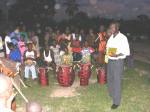
    New beginnings often hide their promise and that appears to be what has happened with the newly formed Dance and Drum Troupe in Amudurasi. Folks began to assemble shortly after six one evening, just as darkness descended. The first drumming lessons and the first tentative dance steps were delivered with the aid of a dim flashlight. The new moon was of little help that night because it remained hidden most of the time behind clouds which threatened to dampen the evening.

    In spite of the darkness which hid the participants, it was an auspicious beginning. An executive of eager volunteers has offered to guide the group. Future practises will continue after dark in order to enable adults to prepare and eat evening meals after they have closed from their work at the market and on their farms. They have already decided to move to the day care building and arrange to have electricity brought from the nearby classroom blocks. Until that is completed they will bring kerosene lanterns from home.

    My good friend, Adamfo Amoako is confident that we will soon have a troupe performing at a very high level. Stay tuned on this blog for more updates on this exciting community development.

  • RAINBOW BLESSINGS CONTINUE

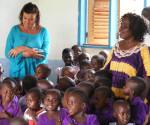
    Monday morning, April 27,  saw young children enthusiastically singing songs and reciting sayings at the Community Day care Centre in Amudurasi in the Ashanti Region of Ghana. Comfort and I introduced our guest, Ietje Rijnsburger, to the children and their two care providers during a brief visit to Comfort’s home village.

    Ietje is the artist and illustrator who produced such great portraits of our family while she was staying at the African Rainbow the previous week. She travelled on Sunday with our son and his friend to Kumasi to witness the tenth anniversary of the enstoolment of the Ashanti King, Otumfuo Osei Tutu II.

    Not only is Ietje an artist, she is also a teacher in her native Holland. She interacted with the children with humour and enthusiasm, and it was clear that she has a love of children matched equally with a love of learning.

    The Day Care Centre opened in October and currently has 86 children registered to attend. The project was first conceived by my wife, Comfort, when we approached the Government of Canada for funding to enable us to construct the Centre. We did not receive the amount which had been requested but were able, through community labour and the provision of land for the building by the chief to begin construction. When the initial funds were exhausted, we set up the Africa Sankofa Fund (http://africasankofafund.blogspot.com) as a registered charity in Canada. Family and friends offered their assistance and collected and donated money, enabling us to complete the first two rooms.

    Ietja’s visit to the Centre was short but it is my hope that we will be able to attract people like her to come and spend more time with our caregivers to share ideas and experiences. Early childcare offers the opportunity for children to interact and learn social skills; to develop their innate creative abilities; to improve motor skills and body awareness. It will never take the place of a mother’s natural nurturing – rather it enhances that which mothers already provide their children. For any readers of this blog who might be interested in such a holiday experience, contact me to find out what might be possible.

  • RAINBOW BLESSINGS COME IN MANY FORMS

    Yesterday was indeed a day of blessings. I have often considered the great good fortunate of owning and living in a hotel, and especially one located at an ocean beach like the one at Busua. The African Rainbow Resort (www.africanrainbowresort.com) has attracted an eclectic selection of wonderful people from all over the world, and we have been fortunate enough to be able to get to know these people, and in many cases, form lasting friendships with them.

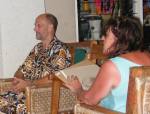
    Yesterday, we were blessed with the presence of the very gifted portrait artist and illustrator, Ietje Rijnsburger, who is visiting Ghana from Holland. In the afternoon and early evening, ­­­Ietje proceeded to sketch in wax pastels each member of our family, producing delightful images which we will cherish for many years to come.

    It has been slightly more than six years since we opened the African Rainbow, and it is people such as Ietje who have shown over and over the great wisdom of my wife, Comfort, when she suggested, while we were still in Canada working on the hotel proposal, that we call our hotel “African Rainbow”. After all she said, our family is a beautiful mixture of colours, and at our resort, we will welcome all the colours of the world who come to visit. Thank you, Ietje, for bringing your colour and light to the African Rainbow.

  • DRUMMING UP A COMMUNITY

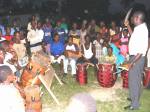
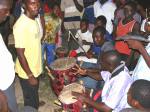
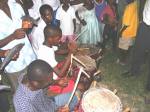
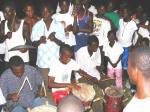
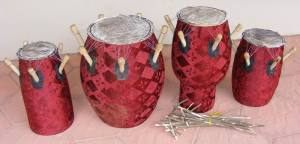
    Adowa Drum Orchestra
    Adowa Drum Orchestra
    Kete Drum Orchestra
    Kete Drum Orchestra

    Drums and dance – an assumed integral part of Ashanti society, right? Well, not so many years ago, such an assumption would have been valid. Today, in 2009, in a society which is bombarded with the culture of the west and at a time when the youth throughout the country have embraced modern communication technology, that is no longer the case. In most rural communities in southern Ghana, one will be hard pressed to find young people who are well versed in traditional drumming and dances.

    Several months ago, I asked my friend, the Cultural Officer, in New Edubiase for some advice on acquiring drums and setting up a cultural troupe in Amudurasi, my wife’s home village. He has been tutoring and supporting a troupe in New Edubiase for a number of years, and he was very excited at the prospect of another troupe nearby.

    My friend accompanied my wife and I one day and we drove to Kumasi. At the Ashanti Cultural Centre, my friend introduced us to the Master Drum Carver who has supplied him with all of his drums in the past. After some discussion and negotiation, he agreed to make two sets of drums for us – a Kete Drum Orchestra and an Adowa Drum Orchestra. Two weeks later we collected the drums and returned to Amudurasi.

    A community meeting was called to let people know that drums were coming to the community. The initial response was very positive and included several unexpected developments. Whereas in New Edubiase, the troupe consists of young students from the community, we discovered that there were as many adults as their were youngsters who were very interested in becoming involved. Some of these adults were proficient dancers and drummers who had learned from childhood. They told us that previously Amudurasi was very well known in the area for the skills of its drummers and dancers, and that the drummers were very much in demand in years gone by. These individuals assured us that they were committed to ensuring that we have a very good troupe as a result.

    Other community members commented on the drums and related them to the new community day care centre which began operation in October. They spoke with great eloquence in expressing renewed enthusiasm and optimism that their village could experience a revival, a renewed vigour that could propel it forward for the economic benefit of all. This was an unexpected response and presents an opportunity for future developments in the community.

    A few weeks later on the occasion of the closing of the funeral celebration for the Edubiase Okyeamehene, we brought the drums to the funeral grounds and announced that they were now in the community. Within moments and impromptu dance had begun as drummers began drumming enthusiastically, and dancers followed suit, anxious to enjoy the music and strut their best moves. What an exciting and unplanned beginning for a project that will have far reaching ramifications.

  • RAINBOW BLESSING

    Today's Rainbow Blessing
    Today's Rainbow Blessing

    In most cases, the stress that we experience in life is self-induced whether or not we choose to take responsibility for it. I am very attracted to the Toltec approach to life, even though at times it is difficult to follow. Our family has experienced some rather unsettling events this week but through these we have managed to maintain a sense of correct thinking and acting. We may have lost the battle over the community access to the beach, but today we have been blessed with the repeat appearance of a rainbow around the sun, a reminder that there are more important aspects of life than the actions of mankind.

  • FINDING MY VOICE

    essay-to-say2

    It has been a slow process, but I am getting closer to “finding my voice”. Last year, as a participant in the first International Writers Workshop to be held in Ghana (see http://www.theinternationalworkshops.com), our workshop leader, Shane Book, encouraged us by reminding us that we have a lifetime of material to write about – it is only a matter of sitting down and writing. Shane’s encouragement and the experience gained during the workshop have been very valuable in the process of recognizing myself as a “writer”.

    Now with the publishing of Rainbow Round the African Sun, and with the recognition which has accompanied it, I am feeling that my voice has gained some legitimacy. The recognition affirms to me that I do have some ideas and experiences that are worthwhile writing about, and that I do have some skill in expressing them.

    My little chapbook Rainbow Round the African Sun has been an important motivator. I have already begun to gather and write works for a more substantial future volume. I am approaching this project with new confidence and a sense of anticipation in meeting this new challenge. My life has been blessed in many ways, and this is just one more blessing.