My life has led me down different paths. Each has brought its own blessing. This is my way of sharing some of them.

  • FUNERALS IN ASHANTI

    If you happen to be passing through the Ashanti Region of Ghana on a Friday afternoon or Saturday, you do not need a calendar to tell you that it is the weekend. Red and black will dominate the colour of the clothing as you drive through any village that is celebrating a funeral. Yes, in Ghana, it is the Ashanti who are known to go to great expense to send their loved ones “back to the village” in style.

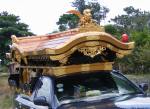
    Funeral homes in North America are known to be certain money makers, and in Ghana funerals have become big business. This very elaborately custom-made hearse was spotted as Comfort and I returned from the village last Friday. When we stopped to take the photos, we were told that it had been brought from Kumasi to be used the following day at the funeral of one of the matriarchs in that village.

  • ONCE A FARMER, ALWAYS A FARMER

    farming-is-farming-3

    A few days ago I drove out to my oil palm farm near Kwame Adjei. My wife, Comfort, and my brother-in-law Nkrumah accompanied me. It is not far from our house – about a kilometre to New Edubiase, then another couple through the town, and east out of town for four kilometres on the Oda road (the one that the previous government promised to pave during the 2004 election – they delivered on the first one and half kilometres and then ran out of interest, or money, or both, or perhaps they hoped, against all evidence to the contrary, that the people would forget, which they did not when the electorate returned the opposition to power and in this constituency in overwhelming numbers).

    At that point, the road arrives at the village of Brunikrom ( the name literally means “white man’s village”, although there are no white people for miles around and the origin of the name remains a mystery to me), and we branch to the right off of the unpaved but reasonably passable dirt road onto a logging trail for the next three kilometres. The trail is narrow and from time to time marked by large holes usually filled with water that hides who-knows-what lurking below. It crosses two low lying marshy areas where makeshift “bridges” consisting of large rough cut timbers and/or tree trunks have been laid to accommodate passing vehicles. These never appear particularly safe but one has little choice but to trust local wisdom and proceed to cross over. Presumably there would be a pile of deserted vehicles mired in the mud if other vehicles had encountered problems but we were the only sign of vehicular life on the trail that day.

    We drove through the small village of Kwame Adjei, across another marshy area, up the short hill that marks the one side of my farm, and a brief distance further I parked the Land Cruiser in the turn off to the next village of Kwame Asare. We began strolling around to see how things were shaping up. The rains have just started, and as with farming everywhere, it is important to time operations well and in harmony with nature. Farmers around the globe face similar weather uncertainties these days – it is no longer as easy to predict the seasons as it once was. Global warming has turned the seasons inside out here and extremes have become the norm.
    farming-is-farming-1

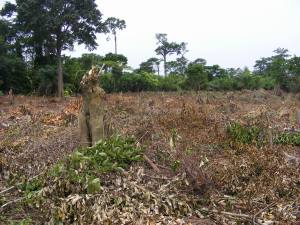
    The farm is approximately 32 acres in size, quite a large area by local standards. The land had been allowed to revert back to an original state for the fifteen years before I purchased it. In the first year, 18 acres were cleared, and oil palm seedlings were planted on 12 acres. Through various errors, two much was cleared and not enough seedlings purchased to plant the entire area, and so the remainder began to grow back. Last year, three acres of that remainder were cleared again and planted.

    The remaining area of several acres has recently been cleared and burned. I will purchase oil palm seedlings the next time I get a chance and have them planted in time to take advantage of this rainy season. The man who has cleared the area will sow maize which will be harvested four months after planting. He will pay for the seed and keep two thirds of the maize crop as payment for his clearing of the land. At the same time, he will plant cassava (a starchy tuber which is one of the main stays in the diet), which will be harvested next year about this time. Half of the cassava crop will be his share and he will be responsible for keeping the area weeded until the cassava is harvested. By making this arrangement, I will minimize my cash outputs for the year. This is a similar arrangement which I made with the same man last year for the three acres.

    Farming is farming, but farming in the tropics is not the same as dryland farming on the Canadian prairies. The past four years have taught me much, and there is still a great deal for me to learn. Unlike the arrangements which I just described, I tried a much different approach in the beginning. I was naïve enough to think that it would be better if I was in control of the inputs and outputs. I contracted people to clear the land, then to plant the seedlings and the corn and the plantain that were to act as cover crops. I was not there to monitor the work on a regular basis, and even when I did go, I really did not know what I should be expecting. It was a disaster!! I spent a considerable amount of money; many of the seedlings did not survive; the maize crop was abysmal; and the plantain developed legs and walked away… The man whom I had hired to oversee the work spent most of his time in the nearby forest reserve searching for kola nuts which he sold in the market for cash. The rest of his time was spent praying with his friends at the mosque in New Edubiase. He apparently was not praying for a successful harvest and as I say, the experience was a disaster and a rather expensive lesson.

    Back on the farm, Nkrumah and Comfort and I continued our walk. I expressed to Comfort my disappointment with the way the farm was going. She listened sympathetically and reminded me that the new arrangements that had been made would yield better results. Of course, I was not particularly convinced that things would get better – at that particular moment I was wondering where I would get the money to buy some more seedlings.
    farming-is-farming-2-jpg2

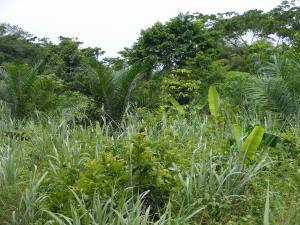
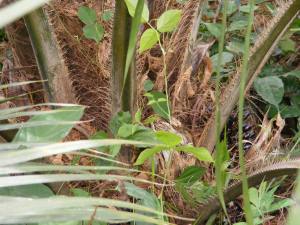
    We were now entering the area that had first been cleared and planted in 2005. Nkrumah pointed out how the first oil palms that had been planted that year were now clearly showing above the undergrowth. He walked over to one of the oil palms and cleared away undergrowth with his cutlass as he walked. He pointed down to the base of the tree and showed me how the first bunch of palm kernels had already formed and was beginning to ripen to that deep red colour that is so distinctive of oil palms. Yes, I had to acknowledge – there was hope.

    After returning to the car, we started to drive back past the farm. Nkrumah stopped me for a moment so that he could pick up a sack of cassava tubers which he had dug while I was taking photos earlier in our walk. He placed them in the back, beside the kuntumeri leaves (greens, much like the spinach grown in my mother’s garden on the farm) which he had gathered on the farm as we walked. I knew that these would later be cooked into a very nutritious and delicious stew, and the cassava would be cooked and pounded into fufu – my favourite meal. There has always been something about eating food that has been grown on your own plot of land – for some reason it always has more flavour and richer colour and better texture.

    The thought of the coming meals put me into a better mood. The drive home was somehow brighter, and I relished a concept that is common to farmers back on the Saskatchewan prairie and that is the idea of “NEXT YEAR”. No matter how bad things seem on the farm at the time and how much money we seem to be losing, we farmers always cling to that one hope, and that is that NEXT YEAR things will be better…. As I say, once a farmer, always a farmer.

  • MUSHROOM SEASON IN ASHANTI

    mushrooms-and-snails

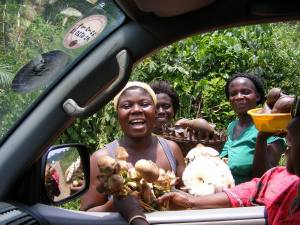
    It has become almost an annual ritual, one which I approach with eager anticipation combined with fear for my demise. I am referring to the mushroom season in Ghana – the time of the year when wild mushrooms are in abundance. The mushrooms provide a unique source of ready cash for many people, both old and young, who live in forested areas of the country where wild mushrooms can be found. Mushroom hunters go out each morning before dawn  to those places where they know the mushrooms can be found and bring them back for sale, usually on the roadside to passing travelers.

    Some of these short term sales people are spontaneous and in for the quick sale, with only a few mushrooms to sell. Young school boys most often fall into this category, hoping to make a bit of spending money before they head off to classes for the day. Others are much more organized, offering a range of types and sizes often attractively displayed on wooden trays.

    Mushroom season is also snail season and where you find one, you will most likely find the other. Forest snails are large with shells measuring up to six inches (15 centimetres) in length. They are also very flavourful and are a delicacy to be enjoyed.

    My anticipation is of course for the scrumptious meals which I will enjoy at the end of the journey. Fresh wild mushrooms and snails are great in local soups when served with my favourite meal of fufu. The mushrooms also add great flavour to pizza toppings and spaghetti sauces.

    As with many things in life, there is a downside, and now I refer to my trepidation mentioned earlier. My wife and I traverse often between Busua, on the coast where our hotel is located, and her home village in the Ashanti Region, where many of the best mushrooms are found. Unlike the ubiquitous fast food places in North America which display signboards well before you reach their location, mushroom sellers show up at the most unlikely locations along the road and without any warning.

    At this time of year, Comfort is focused on her mushroom purchases while I am keeping my attention on safely navigating us to our destination. It is not unusual for us to be clipping along at a nice pace, often times just after I have finally managed to pass a slow moving truck that we have followed for many miles, when, without warning, Comfort will  exclaim “Oh, there are some nice ones!!!” with the expectation that we will abruptly stop so that she can apply her substantial negotiating skills to acquiring more mushrooms to add to the growing pile that she has assembled by her feet on the passenger side. Lorries suddenly appear at our rear and narrowly swerve around us, and the slow moving truck that we have just passed grinds his way by, the driver no doubt enjoying a certain satisfaction from knowing that slow and steady does indeed win the race, and that it will be many miles before I will find a safe place to pass him again.

    Experience has taught me that refusing to stop may be a bigger danger to my health than an unplanned and unsafe stop, and so I have learned to grit my teeth, hold my breath, and roll as safely as I can to the side of the highway. Each year, we go through the same experience, and I must admit, we are still quite alive, and yes, I do enjoy the delicacy of those wild mushrooms. There is one more bonus – the guests who eat in the dining room of our hotel also get to enjoy that same delicacy, and I am sure that they are grateful for Comfort’s persistent roadside stops even if they are unaware of the price my nerves have paid!!

  • The rains came abruptly…

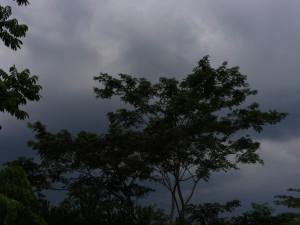
    stormy-sky-at-the-village The rains came abruptly, with little warning, just as darkness was settling in on Friday evening. The rains disturbed the wake keeping by keeping most of the villagers in their homes. A power much larger than the simple plans of man dictated that only the closest family members and the most committed supporters would show up that night.

    My wife and I had travelled to her home village to take part in the funeral celebrations for the late ɔkyeamehene (chief linguist). This was a long awaited event – the man died more than six months ago, but due to circumstances relating to his high ranking position in the Traditional Council, his funeral had been delayed until this weekend. All of the conditions laid out by tradition had finally been met; all of the arrangements had been made; the rains were a humbling reminder of man’s limitations.

    Rather than being distressed by the turn of events, we gave thanks because we knew that these rains would then signal an all clear for the much more important proceedings which would take place the following day. Once again, we could see the wisdom of that higher power, and we privately expressed our gratitude. Life is abundant with such wisdom, if only we are open to receive it.

  • rotated-rainbowroundthesun00251

    Heads up, Folks!

    It is hot off the press!! African Rainbow Round the Sun. Yes, my collection of poems has been published. It is an exciting time for me – my chance to share some of my writing with the the world in book form. After recieving a lot of encouragement from our friend,  Poet/Writer Janet Riehl (www.riehlife.com), I took the plunge and selected poems which represent my interpretation of changes which have been happening in Ghana over the past 37 years since I first stepped foot here.

    African Rainbow Round the Sun is a modest effort with 16 poems in the collection, all but one written the past five years. They are my response to the changes that I have seen in Ghana caused by the forces of globalization and global warming. No one can be immune to these changes, and here in Ghana society copes by adapting as best as it is able. The results are demonstrative of the way in which cultures evolve – some effects are positive while others are quite destructive, representing the yin and the yang of universal forces.

    There is no room for sentimentality and if we see changes that we don’t like then it is up to each of us to do something about it. It is easy to be distracted by our day to day activities of providing basic necessities  as a result, we do not see the bigger picture – we don’t take the actions that are needed in order to influence changes in more positive ways.

    It is my hope that the poems in this collection along with the accompanying end notes may encourage readers to pause for a moment and consider their own surroundings. This applies to readers throughout the world, whether they be here in Africa or elsewhere. Remember – we are all in this together.

    Stay tuned – the book is now available to be sent out by airmail from Ghana. Arrangements are in the works to enable online ordering and payment.