My life has led me down different paths. Each has brought its own blessing. This is my way of sharing some of them.

  • WHAT’S RIGHT WITH THESE PICTURES? Answer 4

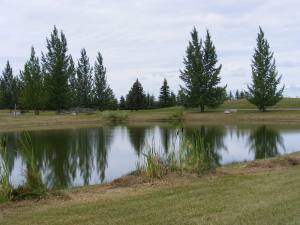
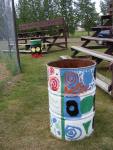
    Park 2GREEN SPACES

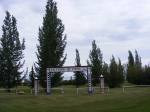
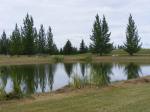
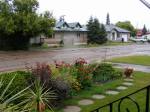
    Before there were villages, mankind lived in nature and we have not forgotten our past. We all enjoy being in “natural” places, where we can be in touch with our ancestral past. That is why western societies have placed such a value on “green space.” A man-made lake was created on the edge of Maidstone, with trout introduced. The area is very popular for those who walk for exercise and families who gather for picnics. In the downtown area, a lot became vacant when an old building was demolished. Rather than rebuilding on the lot, a small “green area” was created with benches to sit on and flowers and shrubs to enjoy.

    Park 3WHAT CAN WE DO?

    Town planners can insist that areas be set aside within communities which provide shade and healthy places for children to play, and for adults to gather and visit. This is increasingly important in larger centres where urban living takes people further away from their rural roots.

  • WHAT’S RIGHT WITH THESE PICTURES? Answer 3

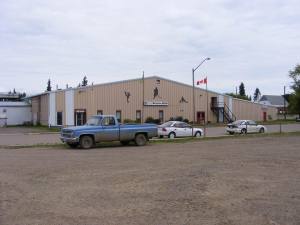
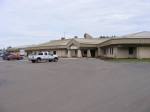
    Arena 2COMMUNITY CENTRES

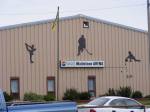
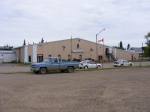
    Communities need a place where they can gather for various events. In Saskatchewan ice hockey and figure skating remain popular sports and Maidstone constructed and continues to operate and maintain their Arena for this and many other purposes. A Trade Fair  is held each year to attract and maintain economic growth in the community. The High School hosts two invitational volleyball tournaments annually and the Arena is used for this purpose. The building and its equipment are maintained through a combination of operational revenue, tax grants plus a substantial amount of volunteer labour by active citizens.

    WHAT CAN WE DO?

    Most towns and villages have playing fields which serve a dual purpose, for football, and for funerals and durbars. Occasionally those areas are sacrificed and sold – let us insist that our leaders remember the importance of community gatherings. Not all communities may be able to afford to build structures, but all can keep an area open for that purpose.

  • WHAT’S RIGHT WITH THESE PICTURES? Answer 2

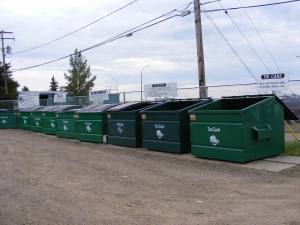
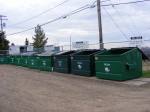
    Recycle 2RECYCLING GARBAGE

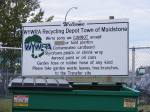
    One result from the onslaught of consumerism in modern society has been an increase in the amount of GARBAGE that is produced. The cost of operating and maintaining landfill sites has become prohibitive. Many Canadian communities have attacked this problem by reducing the amount of materials which are sent to the municipal landfills by sorting those materials which are can be recycled. The list of these materials has grown to include glass, aluminum, certain plastics, newspaper and cardboard. Community residents are also encouraged to separate biodegradable items and these are then composted. The recycled materials provide an economic opportunity, the reduced “garbage” at the landfill sites has created savings to municipal authorities, and the compost is a profitable commodity.

    WHAT CAN WE DO

    The garbage problem has become more and more evident in Ghana as consumer patterns change. Towns and villages which were at one time very clean are now filled with litter. The most obvious examples are the use of plastic bags in the sale of water (sachet bags) and other products (black poly bags). In addition, more and more plastic bottles and jugs and more recently aluminum cans are found in the marketplace and once their uses are exhausted, they are discarded.

    Recycle 1

    We can adapt recycling programs which are suitable to the Ghanaian situation. Plastic sachet bags can be gathered in point-of-sale containers and returned on the trucks that transport the water. Other plastic containers can also be sorted and gathered. Black plastic poly bags can be made with biodegradable components so that they breakdown in a reasonable length of time.

    Compost-able matter can be collected separately from that which is not compostable, and once it has broken down, the results can be used for fertilizer for food crops. In larger centres where there is a large amount of biodegradable matter, methane gas can be collected off of these landfills and be used to generate electricity. (The city of Kumasi has already embarked upon such a program, although there has been no effort to separate biodegradable material from solid waste).

  • WHAT’S RIGHT WITH THESE PICTURES? Answer 1

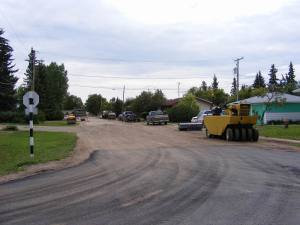
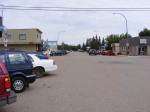
    Road Repairs 3STREET AND ROAD MAINTENANCE

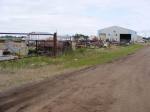
    Street and sidewalk repairs are a very costly item for municipal authorities anywhere in the world. Frost in the winter causes damage every winter in Canada and cannot be prevented. However the town council in Maidstone sets aside funds each year to repair the damages done by this natural phenomenon, keeping the streets maintained and passable.

    WHAT CAN WE DO?

    The concept of a “MAINTENANCE CULTURE” is more frequently discussed in Ghana but it is still rarely practised. It is time for that to change. We all like new things, whether it be houses or automobiles or roads or schools, and we know that keeping those things in good condition requires maintenance. We must insist that our authorities set aside funds out of their annual budgets to ensure that the infrastructure that we have is maintained.

    Road Repairs 1

    It is very unfortunate that my Traditional Area with its seat in New Edubiase has become well known by travellers who ply the route between Kumasi and Cape Coast because of the very bad condition of the highway, with crater-like potholes which cause damage to vehicles and death to drivers and passengers when vehicles try to avoid them. At one time the Highways Department regularly patrolled and repaired such holes before they became a dangerous threat to travellers. When will we see that policy put in place again?

  • WHAT IS RIGHT WITH THESE PICTURES?

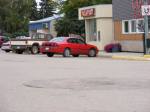
    Maidstone 2

    Here is a quiz for MCE’s and DCE’s, Town and Planning Officers, Assemblymen and Assemblywomen, and all of Nananom.

    Study these photos carefully to find the things which are CORRECT with them. I am currently in Canada visiting my home town, and I recently walked around, taking pictures of features which have captured my attention.

    The quiet town of Maidstone, located in the province of Saskatchewan in Canada, is home to 1200 residents. Agriculture provided the impetus for the establishment of the town just over 100 years ago. It remained the mainstay until oil was discovered in the area about 40 years ago. The community has benefited from the influx of jobs that accompanied the exploitation of the oil deposits, and through the active participation of citizens, the town has remained viable at a time when most other small towns and villages on the Canadian prairies have disappeared. As a result, the population of the town includes a healthy mix of young and old, of children and seniors, supported by the generation who are in their prime productive years providing the economic drive to keep the community vital.

    So, what can we learn from this example? What lessons could we apply to the Ghanaian situation? Agriculture still provides the backbone for the economy of the towns and villages in Ghana, and the recent development of offshore oil reserves can potentially provide the additional revenue to enable communities to be attractive places in which our youth can live and work. In turn, this can stem the urban drift that has put our major cities under so much pressure.

    Keep these ideas in your mind as you look at the photos to see if you can see “what is right with these pictures”. Posts to this blog will follow to point out some of the aspects of this small town which I believe could be implemented in our towns and villages in Ghana to make them better places in which to live.

  • HEADS UP, SASKATCHEWAN.

    Display pic

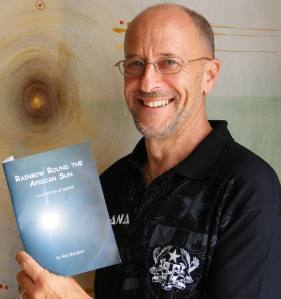
    The following dates have been set for reading and signing of my collection of poems, Rainbow Round the Sun. As we say in Ghana, you are all invited…

    Book signing: August 27, 1:00 to 3:00p.m. Maidstone Pharmacy, Maidstone

    Reading and signing: September 1, 7:00p.m. McNally Robinson Bookstore, Saskatoon

    Reading: September 13, 8:00, FLINT, located on 2nd Ave just north of the Galaxy Theatre, Saskatoon

  • BOOK NOW AVAILABLE FOR SHIPPING FROM CANADA

    Cover photo of the rainbow around the sun
    Cover photo of the rainbow around the sun

    Copies of Rainbow Round the African Sun are now available in Canada. Place orders on the internet from the Book Order page.

  • FUFU – THE FEAST OF KINGS AND QUEENS Insert

    This is an insert for the article “Fufu – The Feast of Kings and Queens” which appears in the Spring/Summer 2009 issue of  “Destination Ghana“. See my previous post.God is love

    For the new initiate, let us look at the ingredients. In the southern parts of Ghana, fufu is most commonly made with cassava and plantain, while in the north it is made from yam. These ingredients are peeled, cut into pieces and boiled until cooked. At that time they are placed into a large wooden mortar and pounded until a starchy ball is formed. The ingredients chosen and the degree to which they are pounded will determine the consistency.

    The connoisseur will then look to the soup. And what a choice there is, each with its own attributes, and each reflecting the unique culinary abilities of the cook and the raw materials at his or her disposal. Light soup may include many different ingredients: tomatoes, garden eggs, onion are most common. Groundnut (known elsewhere as peanut) paste gives nkateε nkwan (groundnut soup) its special flavour and makes that soup very rich and filling, while abε nkwan must be eaten while hot before the palm oil (abε) congeals and makes it difficult to swallow.

    Flavouring is also adjusted by the amount of red pepper and ginger to be added, determined by the preference for hot food. No soup would be complete without a source of protein, and once again there are many choices: fish, both fresh and smoked; poultry, most commonly chicken but on special occasions, dabodabo (duck); meat, both domestic (goat, cow) and wild (grasscutter, antelope).

  • FUFU – THE FEAST OF KINGS AND QUEENS

    This article was written for the Spring/Summer 2009 issue of “Destination Ghana“, published quarterly by FotoMagic Publications in Accra. This magazine is available  on Lufthansa and Virgin Airways flights originating in Ghana. It is also available free at the Silverbird Bookstore in the Accra Mall.

    What does it take to make a man or woman happy for the day? Well, in my case, happiness is a large cold Star beer and a meal of fufu!

    While fufu is the staple for many, it should not be mistaken as a poor man’s food. Rather it is a meal of many choices and combinations, capable of satisfying a broad spectrum of discerning palates. Having said that, fufu is also an acquired taste and is not for everyone. It takes experience to learn to distinguish between soups that are prepared well, and each individual has his or her preference of fufu consistency.

    Chop bars (so named because the manner of eating fufu is to “chop” it with the thumb and two forefingers and then place it in the mouth, taking care to swallow without chewing) are another matter of personal preference. Over the years I have found some favourites and I am happy to share my choices.
    Bamboo chop bar3reduced

    I was first introduced to fufu when I arrived in Ghana in 1971 for a two year teaching contract. When I travelled away from my home village, I would sometimes take a meal at one of the local chop bars but did not particularly enjoy the food. I met my wife some time later and she began preparing soups and fufu. It was only then that I began to fully appreciate well prepared soups – there is nothing quite as good as a meal prepared at home with the love and care that only one’s wife and family can offer.

    Having said that, our lifestyle does not allow us to take all of our meals at home. Sometimes we have to eat out and now, armed with the experience of home cooking, I am better able to discern the best places to eat.

    I am a “country boy,” much happier in a village setting than in the city. Perhaps that is why my favourite chop bars are in rural settings. When we returned to live in Ghana in 2001, we were surprised to see many changes had taken place in the traditional chop bars. Individual wash basins and soap brought to the table replaced the communal wash basin and the bar of Key soap that had been common. Cloth napkins were also offered along with toothpicks. All of these changes were new to us, and I often jokingly referred to each of these features as a level of “Star” rating for each location where we ate.
    Chairman's Base

    A tip to the unsure – if you want to find the best places to chop fufu, ask the taxi or lorry drivers. They always know the best places and their recommendations have never failed me. One of my nephews is an accomplished driver and he has directed me to two of my favourite places. One of these is located on the highway between Accra and Kumasi, in between Anyinam and Nkawkaw. It specializes in “bush meat,” both akrontae (grasscutter) and antelope. The soup is a light soup, always served hot and with the correct amount of  flavour.

    In recent months, my son introduced me to a chop bar located on the Accra-Cape Coast highway midway between Kasoa and Winneba Junction. The owners opened for business in 2002 and have gradually built from a humble thatched shelter on the side of the road to a solid block structure with a high ceiling that remains cool even on the hottest of days. For those who prefer natural shade, there are tables set up nearby under trees. Grasscutter is usually available as is aponkye (goat). The name of the chop bar is Sua Papa Yeε. Auntie Faustie explained to me the meaning: the best gifts are given willingly without expectation of return and these are the best blessings. What a wonderful thought to consider as one dines on the great meals that she and her staff prepare.
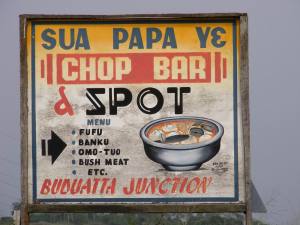
    Sua Papa Ye

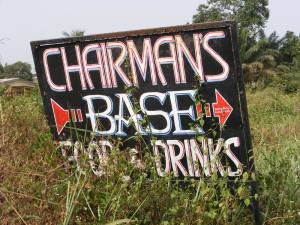
    My wife and I spend considerable time at her home village near New Edubiase in the Ashanti Region. The road to Obuasi passes by two popular chop bars. “Chairman’s Base” is set beside the road and offers conventional fufu and soups along with an assortment of refreshments. Once again there are trees to sit under, or if you prefer, an open dining area shaded by a terra cotta tiled roof. The latest popular music blares from the bar, and it is not uncommon to see “big men” enjoying their meal in the company of lovely young women.

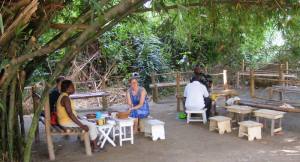
    Several miles from there is the place that receives my “5 Star” rating for the chop bar with the best food and the best ambiance. A small stream meanders beside crude benches cut out of the bamboo which grows in that area. The benches are located under the overhang of a very large bamboo clump. Occasional breezes cause the bamboo to sway gently overhead, ensuring that it is always cool. It is an idyllic setting, and one that attracts a steady clientele of diners from all walks of life – the ubiquitous lorry drivers, market women moving back and forth to the local market towns, professionals and civil servants as they go about their business, and business men and women who have discovered this place and make sure to time their travels so that they can stop here to eat. The choice of food is limited to either grasscutter or antelope – both will delight the palette – and it is not uncommon to see diners packing away enough for two because the food is so good!!

    Of course, once in a while, even country boys are forced to go to the city. In Accra I have checked out a number of places. Asanka Locals in Osu (they also have an outlet in Medina) is a very popular eating spot. It offers a wide range of meals including fufu. Another well known option is the Heavy Do Chop Bar with three locations; Mile 7, Kokomlemle, and Abossey Okai.

    When I travel to Kumasi, my usual meal time destination is Friend’s Gardens. The owners, Charles and Comfort, are always gracious, and the food is consistently great. My favourite is smoked beef in a soup seasoned with seeds from the prεkεsε tree, (which is used as a traditional remedy for the treatment of high blood pressure.)
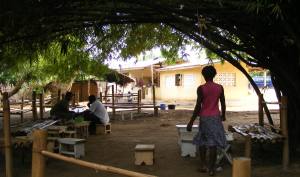
    Bamboo chop bar5

    Any time that we are passing through Cape Coast, we stop off at HomeStyles for a visit with our good friend, Auntie Jo, and of course we also take in a meal of fufu. Light soup with goat meat is our usual choice, along with an opportunity to compare notes on business. HomeStyles is located across the highway from the East Gate to the University of Cape Coast and enjoys a steady patronage from that institution’s faculty and staff.

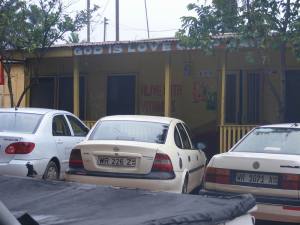
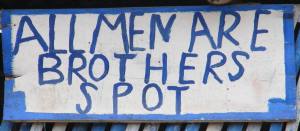
    Frequently business takes me to Takoradi for the day, and of course, what better excuse for a meal of fufu. There are several dining choices, and each offers a great chance to watch people. God is Love Chop Bar is usually packed with diners from various walks of life – business men and women anxious to eat and return to work; civil servants in no hurry to go back to their desks; students from the nearby technical institute enjoying a break from institutional food. Fufu is the only choice on the menu and a local FM station plays popular high life or reggae music, depending on the time of the day. Akroma Plaza serves meals outside under thatched roof structures as well as inside a large air-conditioned dining room where you can watch Nigerian movies on a wide screen television on one side or listen to American country music on the other side. The clientele are usually well-heeled professionals, high ranking civil servants and successful individuals from Takoradi’s business community. The menu offers a wide selection of continental food for those who do not want to take fufu (although as a fufu lover, I cannot imagine why anyone would not want to do so!!)

    Well, there it is – my take on one of the world’s best meals – FUFU, a feast fit for royalty. When next in Ghana, make sure to enjoy the experience. As we say here, “you are invited!”

  • WOMEN’S EMPOWERMENT? OR…

    Sign above the door to a local drinking establishment
    Sign above the door to a local drinking establishment

    I have been a bit slow since our evening of salsa dancing on the Rooftop of the African Rainbow, but there is something from Saturday afternoon’s presentation that keeps coming back to me. It is time for me to wade into a topic which has been weighing on me for some time.

    On the weekend, our hotel hosted an awareness creating conference on the topic of prostate cancer. One of our guests is a medical doctor specializing in cancer research and treatment, with emphasis in the sphere of public health. During his presentation, he compared the availability of information and treatment for breast cancer, which is only experienced by women, with that of prostate cancer, which is only experienced by men. The doctor told us that the National Health Insurance Scheme of Ghana provides payment for treatment of breast cancer but not for prostate cancer.

    The doctor went further to talk about the reasons for the discrepancy between these two treatments. He spoke about the way in which the concept of “women’s empowerment” has left men in a disadvantaged position, and for no reason other than the fact that they are men. The example of prostate cancer illustrated the doctor’s point.

    The concept of “women’s empowerment” is a western idea, and one which grew out of the women’s liberation movement of the 1960’s and 70’s. This was a time of the Peace Movement and a time when “people of colour” were pushing forward their rights, particularly in North America. As a naïve and idealistic socialist, I was a strong supporter of all of these causes. It was clear to me that men and women had equal rights, just as people of all races and sexual orientations were entitled to be treated with those same equal rights.

    In a similar way that Christianity made its way to this continent, well-meaning people brought the women’s liberation movement to Ghana. Those people came with views based on the perspective with which they were familiar – i.e. a western context. As a result, it is currently in vogue in “development circles” to address “gender equity” when foreign aid packages and programs are being decided. In fact this has become so much the case that issues which address community as a whole are often given little or no consideration, in preference for those which purport to enhance “women’s empowerment”.

    In anticipation of the daggers of indignation being drawn, let me hasten to say that I am all in favour of women’s empowerment BUT with one proviso. Let us ensure that the empowerment of women is accompanied by the empowerment of men, as well as that of children. Let us recognize that empowerment of one segment of society at the expense of another is not empowerment at all but rather a form of that which we are trying to rid ourselves and that is colonization and enslavement.

    When I read about foreign NGO’s and aid agencies talking about the way in which this or that project which they have undertaken is going to “empower women and children”, I smile to myself and think about Kejetia and Makola and Fumso and Bolgatanga and Agona Nkwanta and Kasoa and all the other markets, big and small, in Ghana. When walking through any one of those places of commerce, it is clear where the power lies. Yes, perhaps the western business world may still be dominated by men, but in the marketplace, it is women who rule.

    And so before we leave the topic, let us return to the issue of treatment for men’s prostate cancer. Let us here in Ghana not be led astray by the western world. Let us remember that women make up half of the population while men make up the other half, and let us ensure that equality and empowerment is practised in all directions. Remember, men and women, we are all in this together – if we are all sisters, let us acknowledge that we are also all brothers. Let us also ensure that policies which are made in Africa and Ghana are based on an African and Ghanaian context and not one from the western world.