In a recent blog post I exposed a problem that was experienced by an American tourist as he was departing through Kotoko International Airport. The incident involved the improper actions of three Immigration Officials. Several readers have requested that I provide a follow-up to that incident, and I am pleased to relate this reaction from one representative from the Government of Ghana.
Yesterday I forwarded to the Deputy Minister of Tourism a copy of a letter which outlined the incident. In a very quick response (less than five hours after transmitting the message), the Deputy Minister called me to learn more details and to let me know that he shared my concern. He assured me that he will request a meeting with the Head of Immigration in order that the matter be properly investigated and rectified. Wonderful! This is precisely the response which is required. This is the kind of action which will keep our country moving forward.
There are two other sides to this incident which I would like to bring up. Two years ago I submitted my application to the Ministry of Interior to become a naturalized citizen of Ghana. That application has been in the hands of Immigration officials since that time, and I have been assured that the processes will soon be completed. I confided in a friend yesterday that I have been somewhat reluctant to push the issue of the Kotoko incident too far because I did not want to jeopardize my application. He correctly pointed out to me that “no country is worth becoming a citizen of if you have to compromise your values in order to gain citizenship”.
My friend went on to point out that we all have a responsibility as citizens to speak out when we see situations which are not correct. Failure to do is the way in which countries cease to be ruled by just and transparent laws. Of course he was right, and the response from the Deputy Minister has allayed any concerns which I may have harboured. No doubt those in charge of the Immigration Service will also wish to see this problem solved because they do not want the actions of the officials of a few to reflect badly on the Service as a whole.
There is yet another aspect of what has unfolded and it is this: in the 8 years since I returned to Ghana to make it my home, I have witnessed a profound change in attitude in many of the government agencies with which I have dealt. I have seen men and women acting out of a sincere sense of responsibility and with professionalism and self-confidence. These people are a new generation of bureaucrat, people who are of a generation younger than my own (I am now 61), people who do not exhibit the attitudes which we used to have to endure in dealing with anything of an official nature in the early 1970’s when I first came to Ghana.
It is this new generation, as exhibited by the Deputy Minister and many others in agencies as diverse as Immigration, Internal Revenue and Education, who will move this country forward. These people in turn rely on the citizens of Ghana, each of us, to act as guardians of our working democracy by always keeping them on their toes. Let us all take our share of shaking things up when things need shaking.
Stay tuned, for more updates on the incident at Kotoko, and on my application for citizenship.
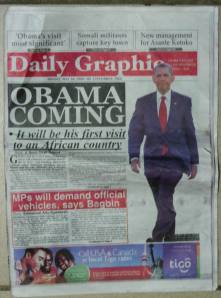
Recent media coverage has given a lot of attention to the hopes which have been attached to the visit of President Obama to Ghana. This week, the Minister of Tourism, Mrs. Juliana Azuma-Mensah spoke about the positive impact of the President’s visit, and she once again reiterated the importance of tourism to the economy of the country.
Meanwhile the reality that faces some of the tourists who are already in the country has illustrated that there is more work to do in areas other than cleaning up the town of Cape Coast. On Tuesday, four days before the arrival of President Obama, one of our guests, also American, went through a harrowing experience at Kotoko International Airport when he was catching his flight to return to the United States. This man had a valid multiple entry visa which had recently been updated when he traveled to Cote d’Ivoire and re-entered Ghana. He was returning to the United States after spending considerable money during his stay in Ghana, and was planning to return at some future time for repeated visits.
Immigration Officers pulled him aside in the Airport and accused him of being in the country illegally. He showed them his American passport and valid visitor’s visa, but to no avail. After being threatened that he would be put in jail, and with the fear that he miss his flight which was soon boarding, the gentleman offered the officials a payment. After much argument in which they requested a larger sum, they finally accepted $300 and allowed him to board the plane. He left Ghana, traumatized by his experience, and firmly convinced that he will never return to this country.
The Minister of Tourism has recently referred to the Obama visit, stating, “Ghana must hang out all her best wares to be captured by the cameras to enhance our domestic earnings for economic growth.” It is clear that there are some Immigration Officials at Kotoko International who are taking the Minister’s pleas quite literally – they are ensuring one of two things:
They have enhanced the domestic earnings of the Immigration Service by collecting this additional fee
OR
They have enhanced their personal earnings for their own personal economic growth.
Is this the experience that the Minister wishes to be captured by the cameras?
Is this the thank you that the Government of Ghana is offering to American citizens who have come to this country to spend money? Perhaps the Minister should turn her attention to matters other than some of the short term window dressing on which her government has suddenly and lavishly spent money if she is sincerely devoted to increasing tourism revenue for this country.
This is not the first time that we have heard of these kinds of incidents at Kotoko. It is imperative for the Government of Ghana to take seriously the issues that beset potential tourists who experience difficulties in getting visas to come to the country, and even more importantly, it is time for the Government of Ghana to ensure that the lasting impression of Ghana that a tourist has is one created by their positive experience while in the the country instead of an incident such as the one which our guest experienced this week at the last point of exit – involving greedy Immigration officials at Kotoka International Airport.
Occasionally incidents make us aware of the way in which we are all interconnected on this globe we call the Earth. Actions, large and small, taken in one place will have effects that we often don’t anticipate. Global warming is perhaps the most ominous example.
Other times, we see the connections and they give us a “feel good” sense of belonging to the larger community of mankind. Recently I snapped this shot. A citizen of Dixcove was walking the road which connects his village to our village of Busua. He was happy to have something to keep the hot sun off his head, and I was happy to enjoy a connection to my home province of Saskatchewan. Greetings to the good people in the little village of Clavet, with a special hello to those who work for Prairie Steel Products.
As you now know if you have been reading this blog, the bridge at Praso has been closed for repairs. Ten days ago, my wife and I decided to detour around it via Oda. With the wisdom of hindsight and past experience, we set off early from New Edubiase at 11:15 a.m. Branching off the highway several kilometres south of town, we were pleasantly surprised to be driving on a recently tarred road, travelling by oil palm and cocoa farms and then into the forest reserve. It was a lovely drive, with only a few short stretches as yet incomplete, and we made a note to remember this drive to take visitors who wish to see the countryside.
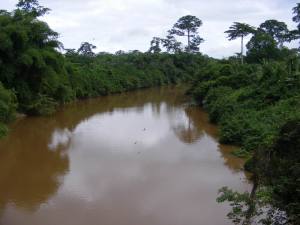
It was not long before we reached the Pra River. We crossed on a short bridge, stopping at the other side for me to snap some quick photos before a truck and passenger lorry approached from the opposite direction. The tarred road ended at the bridge to be replaced by a narrow and rutted path. We soon caught up to a timber truck that lumbered along at a snail’s pace until he reached a knoll and pulled over. Thinking he had done so for my benefit, I quickly slipped on by him, just in time to see the orange Mass Metro bus bearing down on us. I squeezed to the right and the bus passed by.
The road began to improve slightly, and then returned to a tarred surface like the one which we had first encountered. We smiled with assurance and debated where we might begin turning back towards Assin Fosu. Would we have to go all the way to Oda or would there be a turn off somewhere that would shorten the trip? Once again I remembered my excellent road maps, still stored safely in the glove compartment of the car back in Busua!!
The tarred road ended, and turned onto the paved highway which leads into Oda, thus ending the debate. Soon we could see the old single lane bridge over the Birim River on the outskirts of Oda. We passed over, stopping briefly at the Police barricade to inquire about directions to Assin Fosu. The Inspector puzzled over the question for a few moments and then advised us that we ask at the lorry station in town. We were grateful that he was not related to a certain taxi driver – the memory of our wrong turn a few weeks earlier was still with us. If the Inspector did not know, at least he was not giving us an incorrect answer.
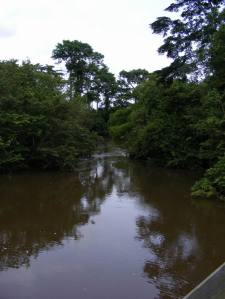
Nana Pra downstream
It took several more inquiries to get on the proper road but soon we were heading towards Akim Swedru, cruising along on a tarred surface, passing through that town until we reached Akim Achiase. The good road promptly ended, and from there until we reached the junction at Assin Brofeyedru, it was slow going. We were not alone on the road, meeting passenger lorries from time to time, often carrying funeral goers.
At one village we drove up to a makeshift blockade, manned by young men dressing in red and black. A timber truck had been stopped on the other side of the blockade and some of the young men were in a discussion with the driver. Several young men came up to our vehicle, asking for one Ghana cedi from us before they would allow us to pass. They explained that the chief of the village had just died and the funds were required in order to celebrate the funeral. We readily made our contribution and were once again on our way.
Finally we passed an intersection which we recognized, even though we had only seen it once before and then in the dark. It was the place where a certain taxi driver could not bring himself to tell us that he did not know the correct way, the junction which set us off on a wrong turn several weeks earlier. Of course, the driver meant no harm – he was only trying to please us by supplying an answer to our question. Chances are that he really did not know where that road passed.
Another few kilometres and we pulled onto the Cape Coast/Kumasi highway at Assin Brofoyedru. It was almost 2:30 and had taken slightly more than three hours to drive a distance that would have been done in less than thirty minutes if we had been able to cross the bridge at Praso. Is it any wonder that so many people are so unhappy with the contractor who was supposed to complete bridge repairs two weeks earlier!!!
The remainder of our return was on familiar turf and by the time we were safely back in Busua, we had visited four of the country’s Regions, beginning in the Ashanti Region, crossing south and east into the Eastern Region, then returning west and further south into the Central Region, and then along the coastal highway to the Western Region. Our trip had begun an hour and half south of Kumasi, taken us through Oda, then skirted around Cape Coast, and bypassed Takoradi.
Four Regions and four Regional capitals in one day and on road surfaces of all types – not bad, I would say. We could only hope that urban dwellers, particularly those in Accra, would consider making such a trip from time to time. Perhaps the awareness which the trip would generated might influence better decisions by taking into account the majority of the nation’s citizens who still live in rural areas. The road less traveled for some is the only road for them.
…. I can tell you that there is one sign my wife and I should have believed when we read it several weeks ago – a sign which can no longer been given much credibility for reasons explained in an earlier blog post.
The sign in question was one advising of the closure for repairs of the bridge over the Pra River on the Kumasi/Cape Coast highway. Four weeks ago, we took a chance that the sign would not apply to us. We were on our way to New Edubiase and it was late in the afternoon when we saw the sign at the junction at Assin Brofoyedru. We knew that if we were allowed to cross the bridge at Praso it was only a short 15 minute drive to our home at New Edubiase. The alternative was a difficult 2 or 3 hour detour on dirt roads and so we proceeded to Praso.
It was 5:45 as we pulled into Praso and parked in front of the accumulated lorries and buses. It did not look good but we walked the next few hundred yards to see what we could learn. The contractor was on the site although there was no work being done and therefore no reason why passenger vehicles could not pass. We asked the contractor, a short stocky very serious looking man, if we could pass over to the other side. He assured us that such a request was out of the question. He told us how the public had been informed of the bridge closure with notices in the “Graphic” and announcements on the radio, as if that was a good enough reason for his decision. We had not heard the news – the Graphic does not come to our village and we seldom listen to radio. Apparently we were being chastened for our lack of awareness.
Nana Pra – upstream
The man clearly was enjoying the position of power which he held. We decided to save our energy from further argument and turned around and headed back to the junction where we had first seen the sign. The sun was disappearing as we turned onto the dirt road to which leads to Oda. Several kilometres down the road we came to another junction. We asked a taxi driver which branch led to Oda and were directed to turn left, which we did. The road started well but soon began to deteriorate. From time to time we encountered junctions and whenever able we asked for directions. Two hours later we pulled up to an intersection – one with a paved road that looked rather familiar. It was as I feared – the very highway which we had been on just over two hours earlier… yes, we had looped back to Assin Akonfode – only a few kilometres from our starting point at Assin Praso!!
New advisors, well meaning all (perhaps related to the taxi driver who gave us the incorrect directions?) suggested that we return to Assin Fosu and head west to Twifo Praso and then north to Dunkwa and on through Obuasi to finally reach our destination, New Edubiase. I have some very good road maps that would have shown this route in excellent detail – of course they were safely stored in the glove compartment of the car which we had left behind in Busua – not much help to us now. It was shortly after 8:00 and seemed too early to give up. I was not tired and so the decision was made and off we set, clambering around and through the huge craters that cover the streets of Assin Fosu. Apparently the Fosu Municipal Authority do not hold street maintenance high on their list of priorities – one can only hope that they are putting their funds into other worthwhile projects that will benefit the citizens of that town. After manoeuvring though the Fosu minefield, we reached a lovely paved road beginning on the outskirts of town. We had nicely gained some speed and were enjoying the road when it suddenly ended and turned into the road from hell, one which was even worse than the worst that we had encountered in the previous two hours.
I lost track of the time and had not had the presence of mind to set the trip meter when we began this sojourn. Suffice it to say that considerable time had passed until we finally reached Twifo Praso. We crossed over the mighty Pra River on an old railroad bridge that is no longer used for trains, although that did not prevent me from imagining a locomotive bearing down on us just as we were half way across. The bridge was questionable, to say the least. It has been crudely modified to accommodate road vehicles, with weathered planking placed between and beside the rails to allow vehicles to straddle them. We were greatly relieved when we made it to the other side of Nana Pra.
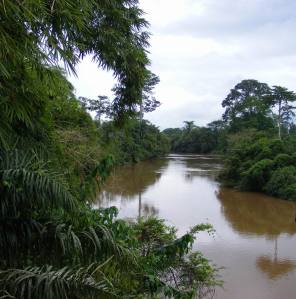
Nana Pra – downstream
Another lovely paved road took us northward but, like the previous one, it abruptly ended and then turned into a narrow lane, no doubt following some ancient route through the bush. Villages were few and far between and were not served by the electrical grid and solar powered street lamps were visible in a few of these communities. We commented to each other that even though our electrical service is not consistently reliable, at least it is much more than these villages enjoyed.
Somewhere along the way, with the road only wide enough for one vehicle to pass and with water filled potholes providing clear evidence of a recent rainfall, we could see that a lorry was travelling a short distance ahead us. We drove for several kilometres and from time to time caught glimpses of his headlights. Suddenly we turned a corner, and there it was – a Nissan van, upside down, roof caved in, wheels still turning, and passengers on the road screaming and crying for assistance.
We stopped. A young man ran up, begging us to help. A woman, clutching a small child to her breast, wailed loudly, telling us that someone was under the lorry. Another man staggered around, clutching his arm and crying out his pain. I backed up, shone the lights on the lorry and got out. My wife tried to calm the distraught woman while I went to the front of the lorry. The driver had gone through the windshield and was lying on the ground. At first he was motionless and I feared the worst. Just at that moment, a Kia truck arrived from the opposite direction. The driver and his mate got down to assess the situation. Just then the lorry driver came back to life and held out his arms. The truck’s mate helped me to pull him clear of the lorry to the edge of the road. Within moments he was standing, still dazed, oblivious of his passengers, and contemplating how he was going to upright his overturned lorry.
Our Land Cruiser was already full with items which we were moving to our house at the village, but we squeezed and made room for the man with the injured arm and set off to the hospital which we were told was up the road at Kyekyewere. All was quiet when we arrived at the hospital, but a watchman assured us that the man would be taken care of. We discharged him, and continued on our way until we finally reached Dunkwa and a paved road. From there the road was familiar to us and we drove on to Obuasi and then on towards New Edubiase, arriving at our house at 1:00 in the morning, thirteen hours after we had set off from Busua.
It had taken us seven hours to drive from Assin Praso in the Central Region to New Edubiase in the Ashanti Region – a drive that would normally have taken fifteen minutes!! We had passed through countryside which we would not likely have ever had any other reason to travel through. It was unfortunate that we could not see the scenery because of the darkness but we were grateful to have arrived finally and safely at our destination. We agreed that a purpose had been served – we had been able to assist some folks along the way and that made the ordeal worthwhile.
When should a sign be believed, and when should it be ignored? Well, that depends. Who is posting the sign? When is it being posted? Let us look at the example of the Ghana Highway Authority to see what we can learn.
What a difference four weeks make! That is how long it has been since the bridge over the Pra River on the busy Cape Coast/Kumasi highway has been closed. This is the main highway used to connect the Central and Western Regions of the country to the Ashanti Region. This is the route used to transport people and goods between Accra and the Adansi area of the Ashanti Regi0n. It is also the main route for goods being transported from the Takoradi Harbour into northern Ghana and the ECOWAS countries to the north. The economy for many miles on both sides of the river has been severely crippled due to the lengthy closure and there seems to be little hope that it will reopen soon.
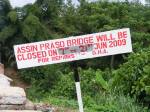
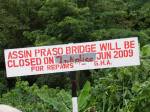
The original signs were posted to promise a closure of the bridge beginning on May 31, and ending on June 15. Those signs have been painted over twice. In the first instance, the date of reopening was extended to June 21. When that date had passed, the sign was painted over again and the date was changed to read “7th to Notice”. No explanation. No apology.
On three occasions in the past three weeks, I have been to check on the status of the work. On each occasion there were no work was being done. The first time, I was on the Assin side for the bridge, hoping to reach New Edubiase. The contractor was at least on site that day. He gave the appearance of someone with whom a great deal of power had been entrusted. He seemed to relish that power which enabled him to prevent anyone from interfering with the important work for which he had been contracted. He appeared to have no sympathy for any of the people who were being inconvenienced.
Road(no)works at River Pra
Several days later I returned to Adansi Praso to inquire about progress. The contractor was not present. I was told that he had gone to Accra, leaving the bridge closed with no work being done. The locals with whom I spoke had no respect for this man – they said that he did not appear to know what he was doing and did not have the equipment required to do the work. On that occasion, I noted that the sign had been changed to indicate that the bridge would reopen on June 21.
Earlier this week, I went again to check on “progress” (if that is the correct word to use). The deck of the bridge had been cleared down to its base so I could see that something had been done since my last visit, but once again the contractor was not present, and no work was being done that day. This time however, a Police Land Rover was parked in the approach of the Assin side of the bridge to ensure that no one could move the trees and various other items which have been used to block the road for motor vehicles. Is it possible that the Ghana Police were called to intervene? Even more troubling was the sign, which had been painted over once again to read this time “Till Notice”.
Throughout the past three weeks I have had numerous conversations with people from various walks of life who have been affected in adverse ways. Farmers are unable to get their produce to market. Market women have no customers because people are unable to travel to the market or to get produce home. The important markets on both sides of the Pra are like ghost towns – instead of drivers being forced to edge along the highway through places like Fumso and Assin Foso on market days, one drives through the same the town as if it were a normal day.
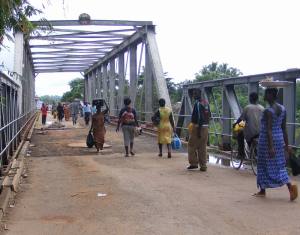
Crossing the bridge
Shop keepers in towns up and down the highway and on feeder roads leading off of it are unable to travel out to replenish stocks. On the Adansi side of the Pra, many petroleum stations have run out of fuel because the tankers cannot get to them. Chop bar owners along the roadside which usually do a brisk business are sitting around waiting for customers.
And throughout this, where is the Minister of Highways? Why is his Ministry tolerating this situation? How did a contract be let out to a contractor who was not serious about his work or qualified to do it? Have we become so casual about inept and slow contractors that we just casually sit back and watch our local economy collapse?
One of the men with whom I spoke three days ago was attempting to deliver urgently required repairs to the mining sector in Obuasi. He commented that such a situation would never occur in a country that was serious about its economy. Rather, workers would have worked in shifts around the clock to ensure that the repairs be done in as short a time as possible so as to cause the least amount of disruption.
So, we ask, Mr. Minister, please check out this situation, and see that the correct thing be done. Let us make it possible for us to move “forward ever, backward never”.
What is really at risk? consumer rights? or profits for South African shareholders?
In January, the South African based multi-national communications giant, MTN, offered to provide me with internet service through their mobile phone system for a flat monthly fee of 20 Ghana Cedis. The flat fee would allow me to transmit any amount of data, and would enable me to be online 24/7. It was a very good offer, better than the one which I had previously had with one of their competitors. I was informed that the modem which I had been using would not work with MTN, but since the offer was such a good one, I agreed to purchase the MTN modem for an amount of 210 Ghana Cedis, and began accessing the internet.
I was particularly pleased because this affordable service would enable me to carry out my plans to mount an international initiative to raise money for a major community development project in the traditional area where I am Nkosuohene (development chief). My strategy required that I establish a presence on the internet by creating a new blog, and by expanding a Facebook account. It included the sale of a new book which I published so that the proceeds could be contributed to support the cause.
The success of this effort hinged on affordable access to the internet when I am in either of my two homes – Busua on the coast where our hotel is located; and New Edubiase where my stool is located. Neither of these rural locations is served by an internet cafe, and affordable access to the internet via mobile phone provided a great alternative. Affordability was a prime concern – I do not get paid for my efforts as Nkosuohene and my income is rather modest, even by Ghanaian standards.
In March I received my first invoice and was surprised to see an amount of 225.48 Ghana Cedis for GPRS service. I inquired at the MTN office in Takoradi where I had signed up for the service. I paid the amount which had originally been agreed upon (20 Ghana Cedis plus 2.50), and was told that the matter would be investigated to see why there was such a discrepancy.
Included with the invoice was a letter from the MTN Chief Marketing Manager dated January 29th with the opening line “We invite you to explore the world of MTN GPRS. Tariffs for this service have been revised for your convenience and cost effectiveness.” At the bottom of the page there was an additional note “Kindly note that you would be automatically migrated to data package 2 (i.e. GHC20/month with 250 MB) on March 1, 2009 if we do not hear from you as we will assume you prefer to continue paying your current fee of GHC 20 per month.”
The rest of the letter talked about monthly packages and buckets and since I had already been offered a flat monthly fee of GHC 20 with no discussion about “buckets”, I did not think that it applied to me. I left the office confident that the matter would be resolved and a correction to my invoice would be made accordingly. After all, MTN is a big company and I had the expectation that it would treat its customers with the same respect and level of service as the very competent staff who looked after me in their Takoradi office.
In April, the March invoice arrived. It showed an outstanding balance carried forward of GHC 241.90, plus an additional amount for GPRS service of GHC 155.26. Once again, I went to the MTN office to question the invoice, and again was told that inquiries were being made on my behalf. I paid the GHC 20 + 2.50 which I felt that I owed, and left the office. Several days later the service was disconnected.
Numerous phone calls and repeat trips to the MTN office ensued, all without avail. The Supervisor of the Postpaid Section of the Accra office attempted to explain that as far back as October, this offer had been terminated. He claimed that therefore there was nothing that could be done except that a payment plan could be negotiated to pay the outstanding balance. I subsequently called the Kumasi office to find out what offer they were making for GPRS service and was told the same thing that I had been told in Takoradi. Something did not add up.
The April invoice arrived in May. Once again I paid the GHC 20 + 2.50, leaving the balance the MTN claims is owed at GHC 438.00!!! Not bad, since I signed up the last half of January and was cut off mid-April, and had paid each month the amount which MTN had asked for. Instead of GHC 20 per month, the GPRS service works out to be closer to GHC 160 per month.
The MTN Regional Manager for the Western and Central Region was brought into the discussion. In the beginning, it seemed that there was some understanding and agreement, but before the matter could be resolved, we were back to the same position put forward by the Postpaid Supervisor, with no acknowledgment of the deceptive fashion in which MTN hooked me into buying their modem.
So here we are now – almost the middle of June. An apparent stand-off. Does the mighty MounTaiN have any intention of honouring the offer which it made? Who is most important to them? Their customers, who provide them the revenue they need to make a profit? Their shareholders, most of whom are back in South Africa, sitting around their board room tables and scanning the map of Africa in search of another pawn in the communication game? We wait to see the answer to these and other questions…
It is good that you have understood my point, and I do hope that you will make it abundantly clear to your superiors in Accra.
This story is going to play out in the media, and now with public access to the internet, be sure that it will play in such a way that the Ghanaian public (and particularly those Ghanaians with more income and who access communication networks like MTN) will know about it. I am currently writing two stories and the one that goes public will be decided by the way in which I am treated. Let me give you the two headlines, along with a brief summary:
Choice 1
Development Chief applauds the MTN Group for bringing access to the internet to rural communities. At a time when communications with the outside world and access to the information available on the internet are becoming so important to the future development of rural Ghana, Nana congratulates this multi-national company for showing the way forward. “It shows how far this country has been able to advance. Through the services of MTN, I have been able to launch a major initiative to raise funding for a major project here in New Edubiase. This new school for performing arts will create more than 100 jobs and will generate a major economic spin-off in the community. At a time when the communication field is becoming so competitive, it is reassuring to know that companies like MTN are concerned about the welfare of rural communities, and are actively playing a role in improving the lives of people who live there.”…..
Choice 2
Non-caring South African based multinational company, MTN Group, after capturing one of the most prized markets in Africa, turns its back on development in rural Ghana. The Nkosuohene (development chief) for the Edubiase Traditional Area has been denied the access to the internet which had been promised, at a critical point where he was about to launch a major international fund raising initiative for the construction of a school for performing arts in New Edubiase. “This is particularly disappointing. A large company such as MTN has created the image in Ghana that they care about this country. Their actions show clearly that they are really only concerned about profits which will be taken out of the country. It is companies such as this which prevent this country from moving forward. Ghanaians deserve much better than that.” says Nana Amoako Agyeman…..
These brief outlines should give you some idea of the ways in which my posts can go. I await your response.
It is official – Rainbow Round the African Sun has been officially launched!!! And there is a big bonus to the event –the “Celebration of Creativity”, hosted by the African Rainbow Resort (www.africanrainbowresort.com) on May 23 and 24. It is the first of many to come, providing a venue for young artists and performers to display their talent during the weekend launch party.
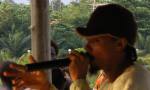
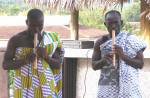
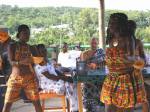
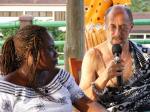
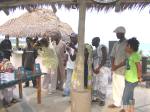
The Rooftop of the Rainbow was filled to capacity with an enthusiastic and appreciative audience. The Saturday evening program began fittingly enough with Ankasa, one of the poems from Rainbow Round the Sun, delivered first in English and then translated into Twi by Nyansa Boakwa. He and his friend, Kweku Atu Kumi accompanied the reading with compositions played on the atentenbene (the traditional flute). Jazz officianado, Bill Courtney gave his rendition of the theme for the evening and throughout the weekend introduced the line-up of performers that followed. Lovely Orkore and her dancers showed us why they are asked back repeatedly to perform in Accra at places like the Golden Tulip. Artist Sir Black delivered a piece from his growing repertoire of “spoken words”. Nii Lartey, also from Accra, evoked many smiles as he demonstrated his verbal skills in his “I will not bore you”. Hip life was also in the house when Jah Wi took the microphone, bringing his messages of wisdom.
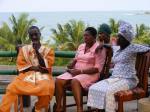
Sunday’s program included all of the previous evening’s performers, along with the youngsters from the Royal Cultural Troupe from Dixcove. Several of the poems from Rainbow Round the African Sun were read, and our chairman for the event, Nana Adomako, Abusiapanin from Kokofu Asaman officially declared the book launched. The party continued into the small hours.
The success of events such as this relies heavily on the coverage that is provided by the media. Big thanks go to Daniel and the GTV crew of the Morning Show, who came from Accra to record the event. Skyy Power TV from Takoradi were also present – thanks to Sista Pama and Bless. Also from Accra we were fortunate to have Nyansa Boakwa from HOT Fm. Last, but certainly not least, from Canada, film maker and documentary journalist, Heiko Decosas, ensured that the event will be seen in that country.
The “Celebration of Creativity” was the first in a series of such events which the African Rainbow will host in order to provide a venue that will encourage the creative arts. Stay tuned – there is more coming up!!
The event draws ever nearer, and preparations are coming together. In response to my reluctance to have a full blown book launch, my daughter has suggested and organized an event which she is calling Celebration of Creativity. It will provide a venue at the African Rainbow for artists and writers and performers to showcase their talent on Saturday evening, May 23, and Sunday afternoon, May 24. The “outdooring” of Rainbow Round the African Sun, a collection of poems will be part of Sunday’s program, and various guests will be invited to read selections from it.
This will be the first of what is planned to be an annual event, and it promises to be a lot of fun. In the Western Region of Ghana, there aren’t any of such events to enable and encourage young creative minds, and this will be our effort to change that situation. Stay tuned for a review of the event next week in Village Rainbows.


















 Village Rainbows