

Category: Culture in Transition

  • ASANTEHENE’S ANNIVERSARY CELEBRATION

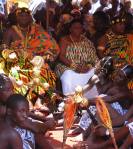
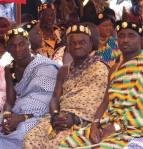
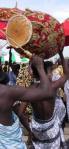
    On Sunday, April 26 in Kumasi, many hundreds of Ashanti chiefs, their elders and their supporters assembled at the Baba Yara Sports Stadium to pay homage to Otumfuo Osei Tutu II, the King of the Ashanti Nation and to celebrate the tenth anniversary of his enstoolment on the Golden Stool. I was one of the chiefs, now a participant in an event instead of being an observer. The change in roles brings with it a much different perspective.

    Five years ago, my wife and one of our daughters and I sat in the bleachers of that same stadium with the thousands of people who came out to witness and offer support through their presence when the fifth anniversary was celebrated. From that vantage point we could watch as the Omanhene entered under their brightly coloured durbar umbrellas, attended and surrounded by Queen Mothers and lower chiefs and supported by drummers beating out their encouragement and horn blowers offering their praises.

    On Sunday morning, the Edubiase Division of the Adansi State made our way to Kumasi. We entered the stadium through the entrance designated for the chiefs. In a crush of umbrellas and drums and humanity, with okyeame juggling for the best position for their chiefs and followers, the chiefs pushed their way into the stadium. The air was filled with a sense of excitement and expectation, in anticipation of the spectacle that we had all knew was about to unfold.

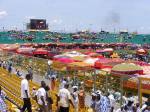
    The Stadium holds 50,000 people – the crowd was large, made up of the King’s subjects plus Ghanaians from other parts of Ghana and foreign visitors and dignitaries, seated in the bleachers around the stadium. The various paramount chiefs and divisions of the Ashanti were assembled on the playing field in designated areas. Seating was at a premium and late comers were sent scuttling around for chairs and when successful in finding them, had to jockey for room to place them.

    Rains had come earlier in the week, leaving clear blue skies out which the sun beat down on those unable to sit under an umbrella. In spite of the heat, the assembled crowd showed no sign of leaving until the last speech had been delivered.

    Large spectacles are difficult to capture in their entirety. The selected photos provide slices of the whole and a sense of the event.

  • THE GREAT WALL

    The Great Wall

    Land litigation is almost a way of life for some folks in Ghana. Even when one is not looking for a quarrel, disputes seem almost inevitable for anyone who has land holdings in the country. My wife and I have experienced our share of these challenges, beginning almost the first week in 2001 that we began building our hotel. One of the parishioners from the community tried (unsuccessfully) to question the boundary which we share with the Methodist Church.

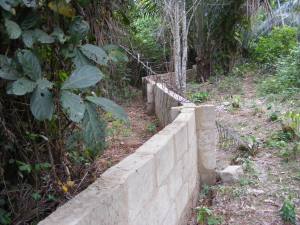
    That encounter was short lived. Fortunately, Comfort had been given some excellent advice three years earlier when we purchased the land. Before she and our daughter returned to Canada that year, she had a cement block wall constructed around the perimeter. The wall was only eighteen inches tall but that was enough to prevent anyone from encroaching and then using the excuse that they did not know where the boundary was supposed to go.

    Our experiences since that time would fill several blog entries, and for Ghanaians who are versed on the subject, these entries would begin to sound too much like déjà vu. They include encroachment by road contractors and by municipal authorities. On more than one occasion, the person who sold the land has continued to occupy and use the land, or attempt to use the land, almost as if they had forgotten that they no longer owned it. Land that has been held in families and subsequently sold by one member is also up for debate when a different person in the family decides that they had not agreed to the sale.

    Most recently, and perhaps most distressingly, we have found ourselves in a situation where a portion of family land held for three generations, with a site plan stamped and signed by the chief, has been sold to another party by the very chief who signed the earlier document. By tradition, a chief has the right to re-enter land which has been leased to someone, however Ghanaian law has set out the correct procedure for this re-entry and for compensation to be made to the party who loses the land.

    Unfortunately, this procedure is often not followed, and land is taken without consultation or compensation. These actions are rarely challenged, often out of ignorance of the law or fear of the traditional authority or a combination of these. Occupation is the best defence, and that requires that a structure be built. In our situation, we already have a house built on the property in question and that should satisfy the requirement that it be developed. Our lawyer has advised that in addition we construct a concrete wall around the perimeter – not an insignificant expense, considering the distance. Now that we have some idea of the legal costs of protecting the property in the court, this seems to be a less expensive option.

    There is an old adage that tells us when it comes to litigation the only winner is the lawyer involved and we can attest to that!! There is another old adage, one which American poet Robert Frost expressed when he told us that “good walls make good neighbours.” Wise words indeed.

  • COPYCAT CULTURE? OR JUST GOOD BUSINESS

    Several years ago, a Ghanaian friend complained that her countrymen could not create anything on their own. She gave many examples of the ways in which products from other parts of the world were copied as if to say that any ideas originating in Ghana were not worthy. My friend had a valid point – examples abound to illustrate her observation

    Taken from another perspective, is that any different from other cultures in other places? Consider architecture. Many of the world’s famous buildings and communities and gardens have been described as “original” and yet incorporate ideas which have been “borrowed” from other creations. And what about fashion? How many times have we seen old styles brought back and presented as the latest fad? Music is yet another area. I often lament the loss of highlife in Ghana as the most popular form of music ever since young musicians have decided to emulate American rap and hip-hop performers.

    Culture evolves as mankind adapts to changing times. We embrace these changes when they force us to re-examine our present, but we need to be ever vigilant that in making changes we do not forfeit valuable aspects of our past. The Sankofa bird which looks back over its shoulder with an egg in its mouth best symbolizes the lesson that we need to know where we are coming from if we want to make the best decisions for our future.

  • FUNERALS IN ASHANTI

    If you happen to be passing through the Ashanti Region of Ghana on a Friday afternoon or Saturday, you do not need a calendar to tell you that it is the weekend. Red and black will dominate the colour of the clothing as you drive through any village that is celebrating a funeral. Yes, in Ghana, it is the Ashanti who are known to go to great expense to send their loved ones “back to the village” in style.

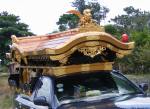
    Funeral homes in North America are known to be certain money makers, and in Ghana funerals have become big business. This very elaborately custom-made hearse was spotted as Comfort and I returned from the village last Friday. When we stopped to take the photos, we were told that it had been brought from Kumasi to be used the following day at the funeral of one of the matriarchs in that village.